
Search
Did you mean: Darius I?
Remove Ads
Advertisement
Search Results

Image
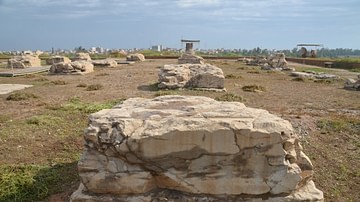
Palace of Darius in Susa
The foundations of the Palace of Darius the Great at Susa (Iran), the capital of Elam and of the Achaemenid Empire. The palace was built on a 12-hectare (29.6 acres) artificial platform and occupied five hectares (12.3 acres). It consisted...
Image
The Apadana of the Palace of Darius in Susa
The Apadana (audience hall) of the Palace of Darius in Susa (Iran) was a large hypostyle room of 36 columns. Measuring 109 metres (357 feet) on each side, it was very similar to that of Persepolis in plan and dimensions with distinctive Persian...
Video
Capital of a column from the audience hall of the palace of Darius I, Susa, c. 510 B.C.E.
Capital of a column from the audience hall of the palace of Darius I, Susa, c. 510 B.C.E., Achaemenid, Tell of the Apadana, Susa, Iran (Louvre)
Speakers: Dr. Steven Zucker & Dr. Beth Harris

Definition
Xerxes I
Xerxes I (l. 519-465, r. 486-465 BCE), also known as Xerxes the Great, was the king of the Persian Achaemenid Empire. His official title was Shahanshah which, though usually translated as `emperor', actually means `king of kings'. He is identified...

Definition
Persian Literature
Persian literature differs from the common definition of “literature” in that it is not confined to lyrical compositions, to poetry or imaginative prose, because the central elements of these appear, to greater or lesser degrees, in all the...

Definition
Ancient Persian Culture
Ancient Persian culture flourished between the reign of Cyrus II (The Great, r. c. 550-530 BCE), founder of the Achaemenid Persian Empire, and the fall of the Sassanian Empire in 651 CE. Even so, the foundations of Persian culture were already...

Definition
Hephaestion
Hephaestion was a member of Alexander the Great's personal bodyguard and the Macedonian king's closest and lifelong friend and advisor. So much so, Hephaestion's death would bring the young king to tears. From 334 to 323 BCE Alexander the...

Article
Alexander the Great & the Burning of Persepolis
In the year 330 BCE Alexander the Great (l. 356-323 BCE) conquered the Achaemenid Persian Empire following his victory over the Persian Emperor Darius III (r. 336-330 BCE) at the Battle of Gaugamela in 331 BCE. After Darius III's defeat...

Article
Discovering the Glories of Persia
Iran, or Persia as it was formerly known, is a country with a long and rich history stretching back thousands of years and where many civilisations thrived. With 24 historical sites registered on the UNESCO World Heritage List and each with...

Definition
Persian Wars
The Persian Wars refers to the conflict between Greece and Persia in the 5th century BCE which involved two invasions by the latter in 490 and 480 BCE. Several of the most famous and significant battles in history were fought during the Wars...
