
Search
Search Results
Collection
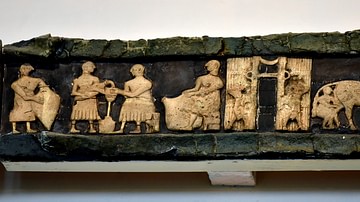
Life in Mesopotamia
Even though Mesopotamia was never a single unified civilization, people led their lives following similar principles throughout the region and across time periods. As the birthplace of cities, agriculture, writing, and civilization in general...

Definition
Ancient Egyptian Culture
Ancient Egyptian culture flourished between c. 6000 BCE with the rise of technology (as evidenced in the glasswork of faience) and 30 BCE with the death of Cleopatra VII, the last Ptolemaic ruler of Egypt. It is famous today for the great...

Image Gallery
The Life of Alfred the Great in 10 Monuments
Alfred the Great ruled the Kingdom of Wessex (England south of the Thames) from 871 to 899. Leading the English resistance to the Vikings, Alfred won several key military victories, built fortified towns and a fleet to enhance his kingdom's...

Image Gallery
Marine Life in Ancient Mediterranean Art
Throughout the history of the ancient Mediterranean artists were always keen to express their appreciation of the bounty of the sea. Marine life of all kinds, real and imagined, was frequently depicted on frescoes, pottery, mosaics and coins...

Collection
The Life of Medieval Knights
In the Middle Ages, knights were at the top of the social ladder. With the best training, the best clothes, the best weapons and, supposedly, the best manners, they were what everyone else aspired to be. Tales of daring deeds and chivalry...

Collection
Plato's Life & Influence
The Greek philosopher Plato (l. 424/423 to 348/347 BCE) is recognized as the founder of Western philosophy, following his mentor, Socrates. He founded the Academy in Athens, traditionally considered the first university in the Western world...
Article
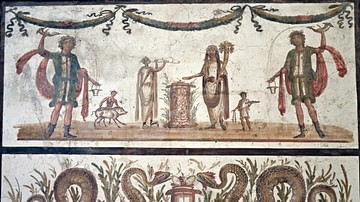
Roman Household Spirits: Manes, Panes and Lares
To the ancient Romans, everything was imbued with a divine spirit (numen, plural: numina) which gave it life. Even supposedly inanimate objects like rocks and trees possessed a numen, a belief which no doubt grew out of the early religious...

Article
Magic in Ancient Egypt
In ancient Egypt, if a woman were having difficulty conceiving a child, she might spend an evening in a Bes Chamber (also known as an incubation chamber) located within a temple. Bes was the god of childbirth, sexuality, fertility, among...

Definition
Field of Reeds (Aaru)
A'Aru (The Field of Reeds) was the Egyptian afterlife, an idealized vision of one's life on earth (also known as Sekhet-A'Aru and translated as The Field of Rushes). Death was not the end of life but a transition to another part of one's...

Definition
The Ankh
The Ankh is one of the most recognizable symbols from ancient Egypt, known as "the key of life" or "cross of life" and dated to the Early Dynastic Period (c. 3150 - 2613 BCE). It is a cross with a loop at the top sometimes ornamented with...
