
Search
Did you mean: Easter?
Remove Ads
Advertisement

 This answer was generated by
 Search Results
Image
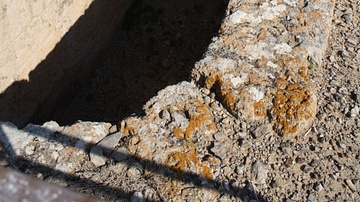
Cistern, Empuries
A Hellenistic cistern at Empuries (Emporiae), Spain. 2nd century BCE.
Image
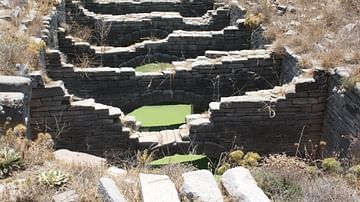
Cistern, Delos
The cistern used to collect rainwater near the theatre, Delos, 3rd century BCE. The eight arches once held the roof and are made from granite blocks. The cistern is the largest on Delos, 8.3 m deep and capable of holding 270 cubic metres...
Image
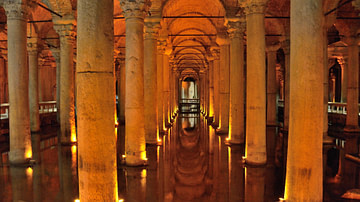
Columns of Basilica Cistern, Istanbul
Located across the Hagia Sophia Museum, Yerebatan Sarayi is also known as the Basilica Cistern because of a basilica that was once located nearby as a cultural centre. It is the largest surviving underground cistern of Istanbul. Fatih Cistern...
Image
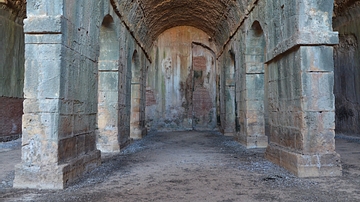
Roman Cistern at Aptera, Crete
The interior of a three-aisled vaulted Roman cistern at the ancient town of Aptera, Crete. It had three barrel-vaulted aisles divided by two rows of four longitudinal arched piers. In the absence of water sources on the hill of Aptera, the...
Article
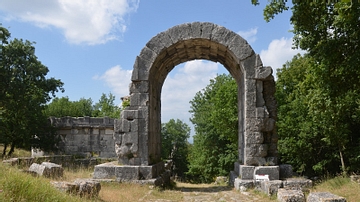
Visitor’s Guide to Carsulae (San Damiano)
Carsulae in Umbria, central Italy, was founded c. 300 BCE and only became a prosperous urban centre after it was connected by the Via Flaminia towards the end of the 3rd century BCE. It was granted the status of municipium and acquired a...
Image
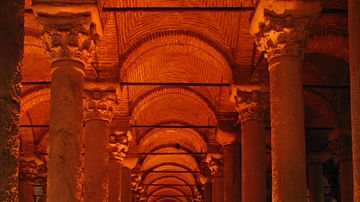
Binbirderek Cistern, Constantinople
Part of the Binbirderek cistern or Cistern of Philoxenos under Istanbul (formerly Constantinople) first built in 330 CE to hold the city's water reserves which were fed by conduits and aqueducts.
Image
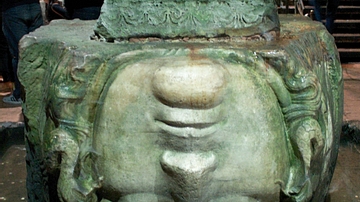
Basilica Cistern, Constantinople
One of two monumental Medusa carvings which hold up columns in the Basilica Cistern of Istanbul (formerly Constantinople). The cistern was constructed in the 6th century BCE reusing the Medusa blocks from an earlier Roman building. One Medusa...

Image
Medusa Head in the Basilica Cistern, Istanbul
An upside-down Medusa head used as a column base in the Basilica Cistern in Istanbul, photograph by Sena Bolek, 2025.
The stone structure is surrounded by dim lighting and shallow water.
Image
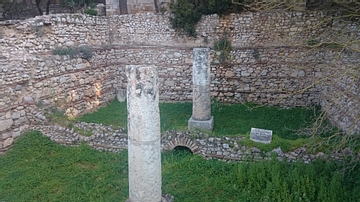
Roman Cistern
Part of the water supply system of the Acropolis building complex.
Construction: 1st - 2nd Century CE
Location: Athens, Greece

Article
Mandu - City of Joy
The city of Mandu is situated about 35 km from Dhar in the Madhya Pradesh region of northern-central India. Most of the city's monuments date to the 15th and 16th century CE. The city is located on a hill which rises 633 m above the sea level...
