
Search
Remove Ads
Advertisement
Search Results

Definition
Dacia
Dacia was a region inhabited by the Dacians in the north of the Danube (modern Romania). The kingdom of Dacia was the creation of Burebistas (c. 80-44 BCE), who conquered and united several other Dacian principalities. Burebistas practically...

Definition
Civil Constitution of the Clergy
The Civil Constitution of the Clergy was a law passed in July 1790 during the French Revolution (1789-1799), which caused the immediate subordination of the Catholic Church in France to the French government. An attempt...

Definition
Hill of Tara
The Hill of Tara is an ancient Neolithic Age site in County Meath, Ireland. It was known as the seat of the High Kings of Ireland, the site of coronations, a place of assembly for the enacting and reading of laws, and for religious...

Definition
Saint Gall
Saint Gall (c. 550 - c. 645 CE), also known as Saint Gallus, was an Irish monk who lived in what is present-day Switzerland during the 6th century CE and was one of twelve companions of Saint Columbanus' Christian mission to the European...

Definition
Mourt's Relation
Mourt's Relation (published 1622 CE) is an account of the first year of the Plymouth Colony founded by the pilgrims who arrived in Massachusetts in November 1620 CE aboard the Mayflower. Its original title was A Relation or Journal...

Article
Constantine’s Conversion to Christianity
Constantine I (Flavius Valerius Constantinus) was Roman emperor from 306-337 CE and is known to history as Constantine the Great for his conversion to Christianity in 312 CE and his subsequent Christianization...

Article
The Mayan Pantheon: The Many Gods of the Maya
The pantheon of the Maya is a vast collection of deities worshipped throughout the regions of Yucatan, Quintana Roo, Campeche, Tabasco, and Chiapas in Mexico and southward through Guatemala, Belize, El...

Article
Religion in the Middle Ages
Religion in the Middle Ages, though dominated by the Catholic Church, was far more varied than only orthodox Christianity. In the Early Middle Ages (c. 476-1000), long-established pagan beliefs and practices entwined...

Article
Trade Goods of the East India Company
The English East India Company (EIC) was founded in 1600, and it came to control both trade and territories in India, as well as a trade monopoly with China. Goods the EIC traded included spices, cotton cloth...
Article
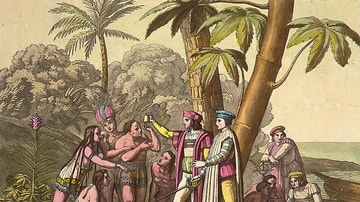
Native American Enslavement in Colonial America
Slavery was practiced by the Native Americans before any Europeans arrived in the region. People of one tribe could be taken by another for a variety of reasons but, whatever the reason, it was understood...
