
Search
Remove Ads
Advertisement
Search Results

Definition
Theseus
Theseus is a legendary hero from Greek mythology who was considered an early king of Athens. Famously killing villains, Amazons, and centaurs, Theseus' most celebrated adventure was his slaying of the fearsome Minotaur in the labyrinth...

Definition
Minerva
Minerva was the Roman goddess of wisdom, medicine, commerce, handicrafts, poetry, the arts in general, and later, war. In many ways similar to the Greek goddess Athena, she had important temples in Rome and was patron of the Quinquatras...

Definition
Hera
Hera (Roman name: Juno) is the wife of Zeus and queen of the ancient Greek gods. Hera represented the ideal woman, was the goddess of marriage and the family, and protectress of women in childbirth. Hera was always faithful to Zeus but...

Definition
Orpheus
Orpheus is a figure from ancient Greek mythology, most famous for his virtuoso ability in playing the lyre or kithara. His music could charm the wild animals of the forest, and even streams would pause and trees bend a little closer...

Definition
Indra - The Vedic Religion's Greatest God
The anthropomorphic god Indra was the most important god in the Vedic religion and he later became a major figure in Hinduism and an important deity in Buddhism, Cham and Chinese tradition. For the Aryas he...
Article
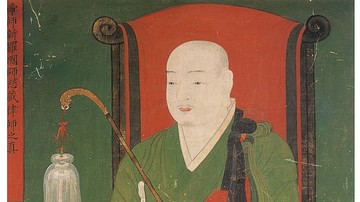
Famous Buddhist Monks of Ancient Korea
Throughout ancient Korea's history Buddhist monks were a particularly important element of state and religious affairs. From the 4th century CE onwards, in the Three Kingdoms period, they were members of a select...

Image
Chinese Junk Ship
A 19th century CE oil painting of a traditional Chinese junk ship, used for ocean-going trade voyages since medieval times. (National Maritime Museum, Greenwich, London)
Image
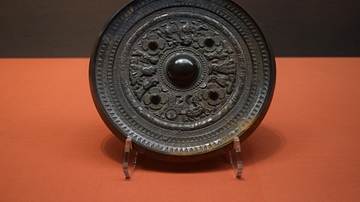
Chinese Bronze Mirror
Engraved Chinese bronze mirror with a deity and horse carriage design. From the 4th-5th century CE Samitatakarazuka Tumulus, Japan. From 2nd-3rd century CE China. Important Cultural Property. (Tokyo National Museum)

Image
Chinese Jade Cormorant
A Chinese jade plaque of a cormorant and fish. 1100-900 BCE. Height: 4 cm. (British Museum, London)

Image
Korean & Chinese Forces Attacking the Japanese Fort of Ulsan
A painting showing Chinese and Korean forces attack the Japanese fort of Ulsan in southern Korea during the Japanese invasions of Korea between 1592 and 1598 CE, otherwise known as the ‘Imjin...
