
Search
Remove Ads
Advertisement
Search Results
Image
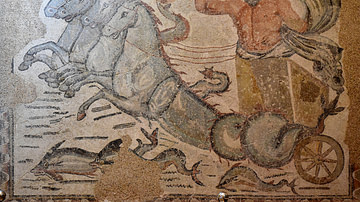
Neptune in his Chariot Mosaic from Timgad
Roman mosaic depicting Neptune in his chariot. The god brandishes his trident as he stands in his chariot, which is drawn by four sea horses. From the East Baths of Thamugadi (Timgad), dated to the 3rd century...
Image
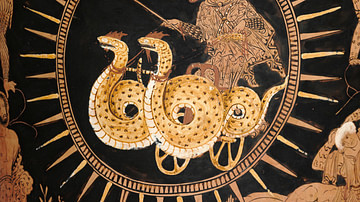
Medea on Her Chariot
Medea flying on her chariot, red-figure calyx-krater (mixing vessel), South Italian, Lucanian, c. 400 BCE.
Cleveland Museum of Art.
Image
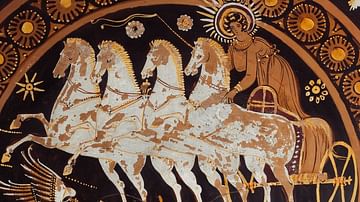
Eos in Her Four-horse Chariot
Eos in her four-horse chariot, detail of terracotta red-figure lekanis vase attributed to the Stuttgart group, from Canosa, late 300s BCE.
Metropolitan Museum of Art, New York.
Image
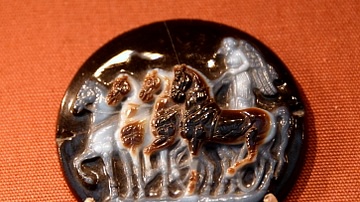
Nike & Chariot Cameo
This sardonyx cameo depicts Nike (Victory). The winged goddess wears a long chiton and drives a 4-horse chariot. Skillful Roman cameo-carvers exploited the tonal contrast of some stones. This could be a simple 2-tone contrast...
Image
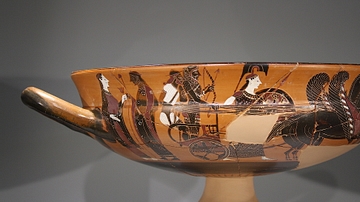
Hercules in Chariot
A black-figure kylix (drinking cup) depicting Hercules being driven in a chariot by Hermes. Athena is to the right. Tarentum, southern Italy, 550-520 BCE. (National Archaeological Museum, Taranto, Italy)
Image
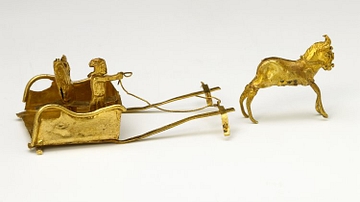
Incomplete Model Chariot
Incomplete model chariot from the Oxus Treasure.
Achaemenid Period (550-330 BCE)
British Museum

Video
Phaethon and the Sun Chariot in Greek Mythology
The figure of Phaethon in Greek Mythology is best known for his attempt to drive the sun Chariot (the chariot of Helios), which ended up with disastrous results. Phaethon was the son of the titan god of...
Article
The Hippodrome of Constantinople
The Hippodrome of Constantinople was an arena used for chariot racing throughout the Byzantine period. First built during the reign of Roman emperor Septimius Severus in the early 3rd century CE, the structure was...

Video
Prize amphora showing a chariot race
Chariot-racing was the only Olympic sport in which women could take part, as owners of teams of horses. Kyniska, a princess of Sparta, was the first woman to win the Olympic crown in this sport. British Museum...
Image
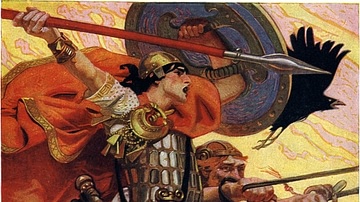
Cú Chulainn in his Chariot
A modern illustration of the Irish-Celtic hero Cú Chulainn, one of the chief characters in the Ulster Cycle. By Joseph Christian Leyendecker, c. 1911 CE. (From 'Myths and Legends of the Celtic Race' by T. W. Rolleston)
