
Search
Did you mean: Galatia?
Search Results
Image
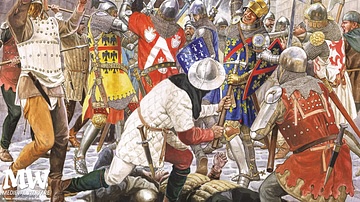
Siege of Calais, 1350 CE
Illustration of the Siege of Calais (1350 CE) during the Hundred Years' War by Marek Szyszko. Courtesy of Medieval Warfare Magazine / Karwansaray Publishers.

Definition
Hundred Years' War
The Hundred Years' War (1337-1453) was an intermittent conflict between England and France lasting 116 years. It began principally because King Edward III (r. 1327-1377) and Philip VI (r. 1328-1350) escalated a dispute over feudal rights...

Definition
Battle of Agincourt
The Battle of Agincourt on 25 October 1415 saw Henry V of England (r. 1413-1422) defeat an overwhelmingly larger French army during the Hundred Year's War (1337-1453). The English won thanks to the superior longbow, field position, and discipline...

Article
Causes of the Hundred Years' War
The Hundred Years' War (1337-1453) was an intermittent conflict fought between England and France that started when king Edward III of England (r. 1327-1377) squabbled with Philip VI of France (r. 1328-1350) over feudal rights concerning...

Article
Battle of Crécy
The Battle of Crécy on 26 August 1346 CE saw an English army defeat a much larger French force in the first great battle of the Hundred Years' War (1337-1453 CE). Edward III of England (r. 1327-1377 CE) and his son Edward the Black Prince...

Article
Battle of Poitiers, 1356 CE
The Battle of Poitiers on 19 September 1356 CE was the second great battle of the Hundred Years' War (1337-1453 CE) after Crécy (1346 CE) and, once again, it was the English who won. Edward the Black Prince (1330-1376 CE), son of Edward III...

Definition
Henry VI of England
Henry VI of England ruled as king from 1422 to 1461 and again from 1470 to 1471. Succeeding his father Henry V of England (r. 1413-1422), Henry VI was crowned the king of France in 1431 but he could not prevent a French revival led by Charles...

Article
The Hundred Years' War: Consequences & Effects
The Hundred Years' War was fought intermittently between England and France from 1337 to 1453 CE and the conflict had many consequences, both immediate and long-lasting. Besides the obvious death and destruction that many of the battles visited...

Definition
D-Day
D-Day was the first day of Operation Overlord, the Allied attack on German-occupied Western Europe, which began on the beaches of Normandy, France, on 6 June 1944. Primarily US, British, and Canadian troops, with naval and air support, attacked...

Definition
Henry V of England
Henry V of England ruled as king from 1413 to 1422. Succeeding his father Henry IV of England (r. 1399-1413), Prince Henry established himself as a fine military leader in battles against English and Welsh rebels in the first decade of the...
