
Search
Remove Ads
Advertisement
Search Results

Definition
Maasai People
The Maasai (or Masai) people are an East African tribe who today principally occupy the territory of southern Kenya and northern Tanzania, and who speak the language of the same name. The Nilo-Saharan Maasai migrated southwards...
Definition
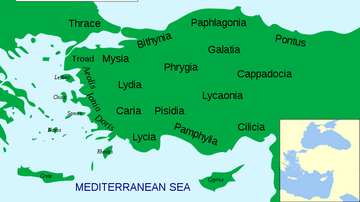
Asia Minor
Ancient Asia Minor is a geographic region located in the south-western part of Asia comprising most of present-day Turkey. The earliest reference to the region comes from tablets of the Akkadian Dynasty (2334-2083 BCE) where it was...

Image
Byzantine Fortress of Petra Justiniana, Georgia
The interior of the Byzantine fortress of Petra Justiniana on the Black Sea in modern-day Georgia near Batumi. As the name suggests, it was built by Emperor Justinian I in 535 CE. The interior of the fortress...

Definition
Battle of the Metaurus
The Battle of the Metaurus (207 BCE) was a military engagement fought between the forces of Rome under Gaius Claudius Nero (c. 237 - c. 199 BCE), Marcus Livius Salinator (254-204 BCE), and L. Porcius Licinius and the Carthaginians...

Definition
Battle of Salamis
The Battle of Salamis was a naval battle between Greek and Persian forces in the Saronic Gulf, Greece in September 480 BCE. The Greeks had recently lost the Battle of Thermopylae and drawn the naval Battle at Artemision, both...

Definition
Battle of Cannae
The Battle of Cannae (2 August 216 BCE) was the decisive victory of the Carthaginian army over Roman forces at Cannae, southeast Italy, during the Second Punic War (218-202 BCE). The Carthaginian general Hannibal Barca (l. 247-183...

Definition
Hoplite - The Key Infantry Soldier of Ancient Greece
A hoplite (from ta hopla meaning tool or equipment) was the most common type of heavily armed foot-soldier in ancient Greece from the 7th to 4th centuries BCE, and most ordinary citizens of Greek city-states...

Definition
Trireme
The trireme (Greek: triērēs) was the devastating warship of the ancient Mediterranean with three banks of oars. Fast, manoeuvrable, and with a bronze-sheathed ram on the prow to sink an enemy ship, the trireme permitted Athens to build...

Image
Byzantine Icon with Koimesis
Made in the late 10th century CE, this ivory icon depicts the Koimesis, or death of the Virgin Mary. Also shown are Saints Peter and Paul. Measures 18.6 x 14.8 x 1.1 cm. (Metropolitan Museum of Art, New York)

Image
Byzantine Child's Tunic with Hood
Child's woolen tunic, dyed in purple, red-brown, and green, with decorative fringes, from Egypt, c. 600-900.
Metropolitan Museum of Art, New York.
