
Search
Remove Ads
Advertisement
Search Results
Image
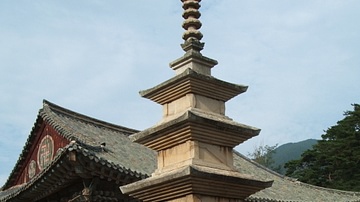
Seokgatap Pagoda, Gyeongju
The Seokgatap Pagoda, part of the Bulguksa Temple at Gyeongju (Seorabeol), the ancient Silla capital, South Korea. The traditional construction date is 751 CE. The structure is listed as a Korean national treasure.
Image
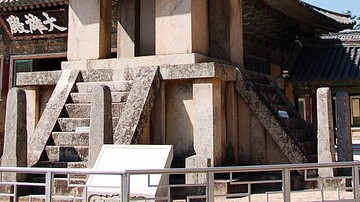
Dabotap Pagoda, Gyeongju
The Dabotap Pagoda, part of the Bulguksa Temple at Gyeongju (Seorabeol), the ancient Silla capital, South Korea. The traditional construction date is 751 CE. The structure is listed as a Korean national treasure.

Article
The Gold Crowns of Silla
The Silla Kingdom ruled south-eastern Korea during the Three Kingdoms period (1st century BCE - 7th century CE) and then, as the Unified Silla Kingdom, all of Korea from 668 to 935 CE. The Silla produced fine pieces of...

Article
The Bronze Bells of Ancient Korea
The metalworkers of ancient Korea were highly skilled artists and some of their finest surviving works are the large bronze bells cast for use in Buddhist temples and monasteries. Both the Unified Silla kingdom and...

Definition
Ancient Korean Sculpture
The sculpture of ancient Korea was dominated by Buddhist themes such as figurines and monumental statues of the Buddha and his followers, and large bronze bells for temples. Gilded-bronze was the most common material used...

Article
The Japanese Invasion of Korea, 1592-8 CE
The two Japanese invasions of Korea between 1592 and 1598 CE, otherwise known as the 'Imjin Wars', saw Toyotomi Hideyoshi (1537-1598 CE), the Japanese military leader, put into reality his long-held plan to...
Article
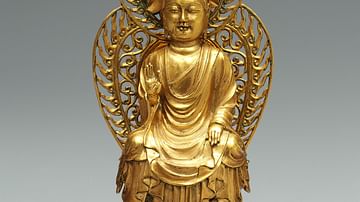
Buddhism in Ancient Korea
Buddhism, in Korean Bulgyo, was introduced by monks who visited and studied in China and then brought back various Buddhist sects during the Three Kingdoms period. It became the official state religion in all Three Kingdoms...

Video
Korean History - Silla Kingdom
The year 57 BCE marks the beginning of the Silla Dynasty. Together with the Goguryeo and Baekje, Silla was the third of the Three States Era, controlling the southeastern region of the Korean peninsula for 1000 years...

Image
Buddha Statue, Seokguram Grotto
A replica of the 3.45 m high granite Buddha of the Seokguram Grotto, an Buddhist artificial cave temple constructed during the Unified Silla Period (668-935 CE) of ancient Korea. It is located near the Bulguksa Temple...

Image
Buddha, Seokguram Grotto, Gyeongju
The 3.45 metre high seated Buddha within the Seokguram Grotto, near the Bulguksa Temple of Gyeongju, South Korea. Silla period, 8th century CE. The figure sits beneath a stone hemispherical dome.
