
Search
Remove Ads
Advertisement
Search Results

Video
History of the Aztec Civilization, a Mesoamerican Empire
The Aztec civilisation spanned from around 1300 CE until 1521, and at its greatest extent, the empire covered most of Northern Mesoamerica. Although we refer to these peoples as ‘Aztecs,’ that is...

Video
The Flavian Dynasty of the Roman Empire
The Flavian Emperors were a dynasty of Roman emperors who ruled from 69 to 96 CE. They consisted of three emperors: Vespasian, Titus, and Domitian. - Vespasian (ruled 69-79 CE) was a skilled military commander...

Article
European Discovery & Conquest of Sri Lanka
The island of Sri Lanka (formerly known as Ceylon) became a focus of European attention soon after the Portuguese entry into the Indian Ocean in the late 15th century. Large swaths of the island would come...

Definition
Babylon - The Gate of the Gods
Babylon is the most famous city from ancient Mesopotamia, whose ruins lie in modern-day Hillah, Iraq, 59 miles (94 km) southwest of Baghdad. The name is derived from bav-il or bav-ilim, which in Akkadian meant "Gate...
Article
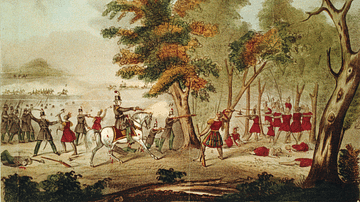
Battle of the Thames
The Battle of the Thames (5 October 1813), or the Battle of Moraviantown, was a decisive engagement in the War of 1812, in which a US army under General William Henry Harrison defeated a British and Native American force in...
Article
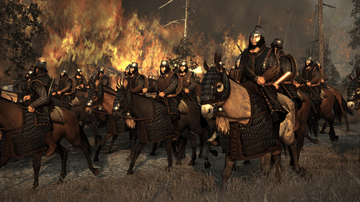
The Battle of the Catalaunian Fields
The Battle of the Catalaunian Fields (also known as The Battle of Chalons, The Battle of Maurica) was one of the most decisive military engagements in history between the forces of the Roman Empire under Flavius...

Image
Map of the Rise and Fall of the Mexica (Aztec) Empire - Alliance, Expansion, and Tribute Power in Mesoamerica
The Mexica (commonly referred to as the Aztecs) emerged as a dominant power in central Mexico during the Late Postclassic period, culminating in the formation...

Definition
Edward Gibbon
Edward Gibbon (1737-1794) was an English historian most famous for his influential work The History of the Decline and Fall of the Roman Empire, volume one of which was published in 1776, with the final sixth volume coming in 1788...

Definition
Ashurbanipal
Ashurbanipal (r. 668-627 BCE, also known as Assurbanipal) was the last of the great kings of Assyria. His name means "the god Ashur is creator of an heir" and he was the son of King Esarhaddon of the Neo-Assyrian Empire. In the Hebrew...

Definition
Attila the Hun
Attila the Hun (r. 434-453 CE) was the leader of the ancient nomadic people known as the Huns and ruler of the Hunnic Empire, which he established. His name means "Little Father" and, according to some historians, may not have...
