
Search
Remove Ads
Advertisement
Search Results

Article
The Ajanta Caves
The 30 caves at Ajanta lie to the north of Aurangabad in the Indhyadri range of Western Ghats. The caves, famous for their temple architecture and many delicately drawn murals, are located in a 76 m high, horseshoe-shaped escarpment...

Article
The Twelve Tribes of Israel
The Twelve Tribes of Israel refer to the sons of the Jewish Patriarch Jacob and are important for the tribal lineages of those who constituted the nation of Israel. In the ancient world, all ethnic groups developed stories...

Article
Copies & Fakes in Art during the Renaissance
The Renaissance period witnessed a great renewed interest in the art of antiquity. There was an appreciation of the technical skill required to produce such objects as a Roman marble figure of Venus and...

Article
Hellenistic & Roman Agora of Athens
Pericles’ agora of Athens flourished under Macedonian control. After Macedon was defeated by Rome, the Romans added to the district even before Greece was taken as a province and more so afterwards. The Roman version...

Article
Colonel Blood & the Theft of the Crown Jewels
Colonel Thomas Blood, a known conspirator, made an infamous but unsuccessful attempt to steal the British Crown Jewels from the Tower of London in 1671. Disguised as a clergyman, Blood and his gang swiped...

Article
Chester: A Time-Travelling City
It is said that Chester is the richest city in Britain in terms of archaeological and architectural treasures. One of the finest strategic outposts of the Roman Empire, it is one of the few walled cities left in Britain...

Article
Battle of Waterloo
The Battle of Waterloo (18 June 1815) was the last major engagement of the Napoleonic Wars (1803-1815), fought by a French army under Emperor Napoleon I (r. 1804-1814; 1815) against two armies of the Seventh Coalition. Waterloo...
Image
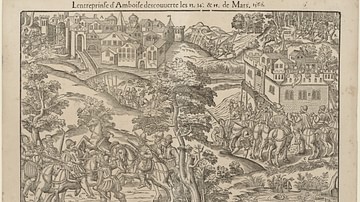
Conspiracy of Amboise
Consipiracy of Amboise, March 1560, engraving by Jacques Tortorel.
National Library of France, Paris.
Image
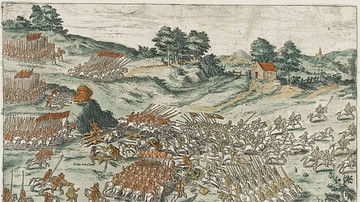
Battle of Jarnac
The Battle of Jarnac (13 March 1569), engraving by an unknown artist, 16th century.

Image
Battle of Ramillies, 1706
The Battle of Ramillies, 1706, illustration by Henri-Louis Dupray, c. 1900.
Depicted here is the Duke of Marlborough receiving captured French standards after the Battle of Ramillies.
