
Search
Did you mean: Themis?
Remove Ads
Advertisement
Search Results

Definition
Gustavus Adolphus
Gustavus Adolphus (l. 1594-1632; r. 1611-1632) was the King of Sweden who elevated his country to a major power in the 17th century. He also is traditionally recognized as the "Father of Modern Warfare" for his military innovations...

Definition
Antonín Dvořák
Antonín Dvořák (1841-1904) was a Czech composer best known for his symphonies, symphonic poems, operas, and chamber music. Dvořák's best-loved works include his 9th Symphony (From The New World), the American quartet, and his Slavonic...

Definition
Celtic Coinage
The coinage of the ancient Celts, minted from the early 3rd century BCE to the 1st century CE, at first imitated Greek and then Roman coins. Celtic engravers then soon developed their own unique style, creating distinctive coins...

Image
The Seven Prince-Electors of the Holy Roman Empire - The Golden Bull and the Election of the King of the Romans
The Holy Roman Empire (962–1806) was a decentralized political order in which authority was shared among the monarch, territorial princes, ecclesiastical...

Article
Grief & Consolation in Chaucer's Book of the Duchess
In Geoffrey Chaucer's first major work, The Book of the Duchess (c. 1370 CE), two genres of medieval literature are combined – the French poetic convention of courtly love and the high medieval dream...
Article
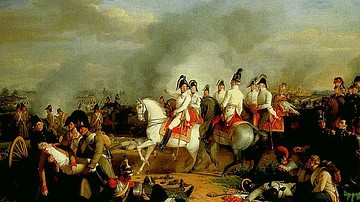
Battle of Aspern-Essling
The Battle of Aspern-Essling (21-22 May 1809) was a major battle of the Napoleonic Wars (1803-1815). It saw an Austrian army under Archduke Charles defeat a French army led by Emperor Napoleon I (r. 1804-1814; 1815) as...

Article
Battle of Leipzig
The Battle of Leipzig (16-19 October 1813), or the Battle of the Nations, was the largest battle of the Napoleonic Wars (1803-1815), featuring over half a million soldiers and resulting in over 100,000 total casualties. The climax...

Article
Battle of Crécy
The Battle of Crécy on 26 August 1346 CE saw an English army defeat a much larger French force in the first great battle of the Hundred Years' War (1337-1453 CE). Edward III of England (r. 1327-1377 CE) and his son Edward the...

Definition
Ancient Celts
The ancient Celts were various tribal groups living in parts of western and central Europe in the Late Bronze Age and through the Iron Age (c. 700 BCE to c. 400 CE). Given the name Celts by ancient writers, these tribes and their...

Definition
Carolingian Dynasty
The Carolingian Dynasty (751-887) was a family of Frankish nobles who ruled Francia and its successor kingdoms in Western and Central Europe during the Early Middle Ages. The dynasty expanded from Francia as far as modern Italy...
