
Search
Did you mean: Wall?
Remove Ads
Advertisement
Search Results

Video
Gertrude Bell - Britain's 'Queen of the Desert
Gertrude Bell was a global adventurer, linguist, spy, archaeologist, and much more. She was responsible for defining the borders of modern-day Iraq, and founded the country's first museum. However, her...

Image
Korean Buddhist 'Emille' Bell
The large cast-bronze bell known as the Emille Bell at Bongdeoksa, Unified Silla Kingdom, Korea. It was cast in 771 CE to honour King Seongdeok. 3.3 metres tall and over 2.2 metres in diameter, it is decorated with...

Article
The Bronze Bells of Ancient Korea
The metalworkers of ancient Korea were highly skilled artists and some of their finest surviving works are the large bronze bells cast for use in Buddhist temples and monasteries. Both the Unified Silla kingdom and...

Image
Archaic Greek Bell Cuirass
A Greek "bell cuirass" from the Archaic Period, made sometime between the 7th and 6th Century BCE. This cuirass came from the Greek mainland and was the antecedent to the later and more recognizable "muscle cuirass"...

Image
Gamla Uppsala, Bell Tower
Bell Tower at Gamla Uppsala, Sweden, site of the Norse Temple at Uppsala, which was destroyed by King Inge of Sweden, c. 1080.
Image
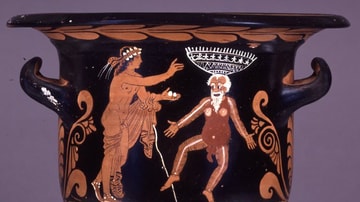
Comic Scene, Bell-krater, Paestum
A red-figure bell-krater from Paestum 360-340 BCE. In a scene from Greek comedy, Dionysos is depicted with a comic actor balancing a basket on his head. The actor is in typical costume - padded stomach, added phallus...

Image
Ritual Dotaku Bell
A bronze Japanese dotaku or ritual bell. From Nakagawa (Akugaya), Hosoe-cho, Kita-ku, Hamamatsu-shi, Shizuoka, Japan. Yayoi Period, 1st-3rd century CE. (Tokyo National Museum)

Image
Ivan the Great Bell Tower
Ivan the Great Bell Tower in the Kremlin, Moscow, Russia. Built in 1508. Photo taken in 2004.
Image
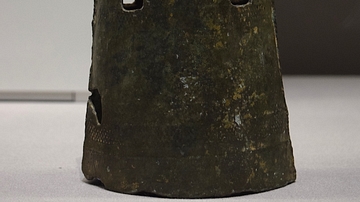
Dotaku Bell, Yayio Period
A bronze dotaku bell, Yayoi Period, 4th-2nd century BCE, Japan. (Tokyo National Museum)

Image
Musical Scene on a Bell Krater
A relaxed scene from a krater (wine-mixing vessel). Ttwo women listen while a third plays the lyre. Attributed to the Danaë Painter, c. 460 BCE. Attica, Greece. (Metropolitan Museum of Art)
