
Search
Did you mean: Selinus?
Remove Ads
Advertisement
Search Results

Definition
Tsar
Tsar (also czar) is a Slavic term derived from the Latin caesar. Ivan III (Ivan the Great) (r. 1462-1505) was the first Russian ruler to begin using the title of tsar during his reign instead of the title Grand Prince of Moscow. His grandson...
Definition
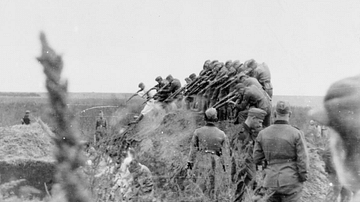
Einsatzgruppen - The Nazi Killing Squads of WWII
Einsatzgruppen ('deployment groups') were secret Nazi killing units, who systematically sought out and murdered civilians identified as enemies of the Third Reich. Operating without any legal restrictions...

Definition
Alfred Rosenberg - The Infamous Nazi Race Theorist
Alfred Rosenberg (1893-1946) was an Estonian-born Nazi who propounded anti-Semitic racial theory and anti-Christian values. Rosenberg's theories matched those of the leader of Nazi Germany Adolf Hitler...

Definition
Oradour-sur-Glane Massacre
The Oradour-sur-Glane massacre in southwest France was the murder on 10 June 1944 of 643 civilian men, women, and children by the Waffen SS during the Second World War (1939-45). The massacre and the razing to the ground...

Definition
Indo-European Languages
The Indo-European languages are a family of related languages that today are widely spoken in the Americas, Europe, and also Western and Southern Asia. Just as languages such as Spanish, French, Portuguese and Italian are...

Article
Roman Glass
Roman glassware includes some of the finest pieces of art ever produced in antiquity and the very best were valued higher than wares made with precious metals. However, plain glass vessels such as cups, bowls, plates, and bottles...

Article
Battle of Smolensk in 1941
The Battle of Smolensk in 1941 ended in victory for Nazi Germany and its Axis allies against the USSR's Red Army during Operation Barbarossa in the Second World War (1939-45). Smolensk on the Dnieper (Dnepr/Dnipro) river...

Article
The Red Army in WWII
The Red Army of the USSR began the Second World War (1939-45) with a series of shocking defeats, but from late 1942, it rallied and held on to key cities like the capital Moscow, Leningrad (Saint Petersburg), and Stalingrad...
Article
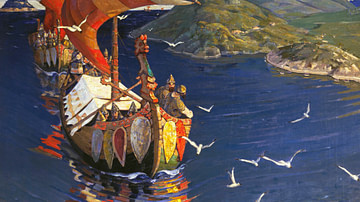
Trade & Warfare in the Kievan Rus
Scandinavians from the island of Gotland began to spread throughout the Baltic region along the Russian rivers in the 700s. While the Vikings of Norway and Denmark from the 8th to 11th centuries are widely recognized...

Article
Consequences of the Bolshevik Revolution
The long-term goal of the Bolsheviks, who took power by force in Russia in November 1917, was a fairer society where workers and peasants were not exploited by wealthy capitalists. The more immediate consequences...
