
Search
Remove Ads
Advertisement
Search Results

Definition
John Stuart Mill
John Stuart Mill (1806-1873) was a highly influential English philosopher of the Victorian Era. His writings were influenced by the Enlightenment thinkers and German Romanticism. Besides philosophical works, he wrote on mathematics...

Definition
Olympias
Olympias (c. 375-316 BCE) was the second wife of Philip II of Macedon (r. 359-336 BCE) and the mother of Alexander the Great (r. 336-323 BCE). Olympias was the driving force behind Alexander's rise to the throne and was accused of having...
Definition
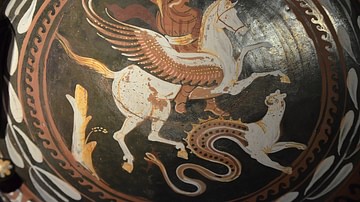
Bellerophon
Bellerophon (aka Bellerophontes) is the Corinthian hero of Greek mythology who famously battled and killed the fantastical Chimera monster, a fearsome fire-breathing mix of lion, goat, and snake. Bellerophon was the son of Poseidon...
Definition
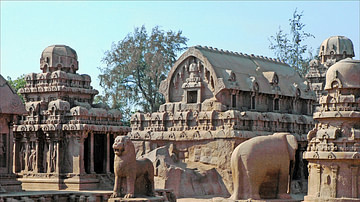
Mahabalipuram
Mahabalipuram or Mamallapuram is a historic city and UNESCO World Heritage site in Tamil Nadu, India. During the reign of the Pallava dynasty, between the 3rd century CE and 7th century CE, it became an important centre of art...

Definition
Ceres
Ceres is the goddess of agriculture and the harvest in Roman mythology. Her favor would bring humankind plentiful harvests and fruitful crops, but her wrath brought blight, drought, and famine. Usually depicted as a matron, her symbols...

Definition
Nephthys
Nephthys was one of the original five gods of ancient Egypt born of the union of Geb (earth) and Nut (sky) after the creation of the world. She was the fourth born after Osiris, Isis, and Set and was the older sister of Horus (usually...

Definition
Dhammapada
Tipitaka (Sansktrit: Tripitaka), the Buddhist canon, consists of three pitaka (Tri means three and Pitaka refers to boxes), namely Vinaya or Monastic regimen, Sutta (Sanskrit: Sutra) or Discourses and Abhidhamma (Sanskrit: Abhidharma...

Definition
Ramayana
The Ramayana is an ancient Indian epic, composed some time in the 5th century BCE, about the exile and then return of Rama, prince of Ayodhya. It was composed in Sanskrit by the sage Valmiki, who taught it to Rama's sons, the twins...

Definition
Tale of Genji
The 'Tale of the Genji' or Genji Monogatari, written in the 11th century CE by Murasaki Shikibu, a court lady, is Japan's oldest novel and possibly the first novel in world literature. The classic of Japanese literature, the work...
Definition
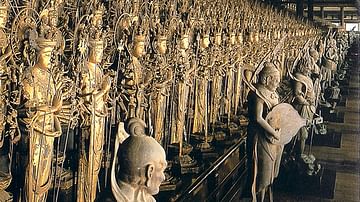
Sanjusangendo
Sanjusangendo is a Buddhist temple which is part of the Rengeo-in monastery in Kyoto, Japan. Founded in 1164 CE, the temple is famous for its impressive dimensions and the 1,001 golden Buddha figures and 28 guardian statues which...
