
Search
Remove Ads
Advertisement
Search Results

Definition
Robert Boyle
Robert Boyle (1627-1691) was an Anglo-Irish chemist, physicist, and experimental philosopher. Boyle was a prolific author, made significant experiments with air pumps, and presented the first litmus test. A founding member of the...

Definition
Albrecht Dürer
Albrecht Dürer (1471-1528) was a German Renaissance artist who is considered one of the greatest painters and engravers in history. A native of Nuremberg, Dürer was famous in his own lifetime at home and abroad for his oil paintings...

Definition
Democritus
Democritus (l. c. 460 - c. 370 BCE) was a Greek philosopher and younger contemporary of Socrates, born in Abdera (though other sources cite Miletus) who, with his teacher Leucippus (l. 5th century BCE), was the first to propose an...

Definition
Civilization - From Nomadic Life to the Farm and City
Civilization (from the Latin civis=citizen and civitas=city) is a term applied to any society which has developed a writing system, government, production of surplus food, division of labor, and urbanization...
Definition
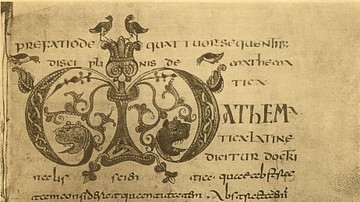
Etymologiae
The Etymologiae (Etymologies) is a Latin work by Isidore of Seville (l. c. 560 - 636 CE), compiled in the early 7th century CE and published in its final form shortly after his death. The book is a type of medieval encyclopedia and...

Interview
Interview: King of the World by Matt Waters
In this interview, World History Encyclopedia sits down with author Matt Waters to chat about his new book King of the World: The Life of Cyrus the Great published by Oxford University Press. Kelly: Can...

Article
Herodotus on Babylon
The description of Babylon and Babylonian customs in Histories by the Greek historian Herodotus (l. c. 484-425/413 BCE) has long been challenged for accuracy and been found wanting, leading some scholars to dismiss the work...

Definition
Near East - A Modern Term for an Ancient Land
The 'Near East' is a modern-age term for the region formerly known as the 'Middle East,' comprising Armenia, Cyprus, Egypt, Iraq, Iran, Israel, Jordan, Lebanon, Palestine, Syria, and part of Turkey, corresponding...

Definition
Cuneiform - The Writing System That Made History
Cuneiform is a system of writing first developed by the ancient Sumerians of Mesopotamia circa 3600/3500 BCE. It is considered the most significant among the many cultural contributions of the Sumerians...

Definition
Sargonid Dynasty
The Sargonid Dynasty was the last ruling house of the Neo-Assyrian Empire from 722-612 BCE, beginning with the reign of Sargon II and ending with fall of the Neo-Assyrian Empire. Some of the most famous kings in the history of...
