
Search
Remove Ads
Advertisement
Search Results
Definition
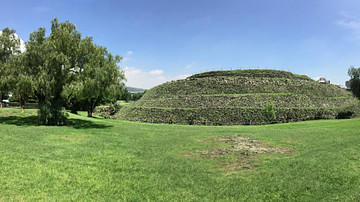
Cuicuilco
Cuicuilco is an ancient settlement site in central Mexico, now located in southern Mexico City. Prominent in the late pre-Classic period, around 500 BCE, it is noted for its large circular temple mound, one of the earliest monumental...

Definition
Enheduanna - The World's First Author Known by Name
The Akkadian poet Enheduanna (circa 2300 BCE) is the world's first author known by name and was the daughter of Sargon of Akkad (Sargon the Great, reign 2334-2279 BCE). Whether Enheduanna was, in fact...

Definition
Nergal - The Mesopotamian God of Death, War, and Destruction
Nergal (also known as Erra and Irra) is the Mesopotamian god of death, war, and destruction. He began as a regional, probably agricultural, god of the Babylonian city of Kutha in the Sumerian...

Definition
God's Wife of Amun
The position of God's Wife of Amun was one of the most politically powerful and spiritually significant in later Egyptian history. Elevated from a figurehead in the New Kingdom (c.1570-1069 BCE), the God's Wife of Amun would...

Definition
Apophis
Apophis (also known as Apep) is the Great Serpent, enemy of the sun god Ra, in ancient Egyptian religion. The sun was Ra's great barge which sailed through the sky from dawn to dusk and then descended into the underworld. As it sailed...

Definition
Saturnalia - The Jolliest of Roman Festivals
The Saturnalia was an enduring Roman festival dedicated to the agricultural god Saturn which was held between the 17th and 23rd of December each year during the winter solstice. Originating from archaic agricultural...

Definition
Ancient Egyptian Mythology
Egyptian mythology was the belief structure and underlying form of ancient Egyptian culture from at least c. 4000 BCE (as evidenced by burial practices and tomb paintings) to 30 BCE with the death of Cleopatra VII, the...

Definition
Inti
Inti was the Inca god of the sun and considered all-powerful but he was also a benevolent god and capable of great generosity. However, Inti could be angered and he would demonstrate his displeasure through solar eclipses which necessitated...

Definition
Brahmanism
Brahmanism (also known as Vedic Religion) is the belief system that developed from the Vedas during the Late Vedic Period (c. 1100-500 BCE) originating in the Indus Valley Civilization after the Indo-Aryan Migration c. 2000-1500 BCE...

Definition
Cherub
A cherub (pl. cherubim) was a divine being who dwelt in the heavenly realm of the gods, either as a servant or a mediator between humans and the divine. The word most likely derived from the Akkadian karabu ("to bless"). The cherubim...
