
Search
Did you mean: Fayum?
Remove Ads
Advertisement
Search Results

Definition
Amenhotep III
Amenhotep III (c. 1386-1353 BCE) was the ninth king of the 18th Dynasty of Egypt. He is also known as Nebma'atre, Amenophis III, Amunhotep II, and Amana-Hatpa, all of which relate to the concept of the god Amun being satisfied or, as in the...
Image
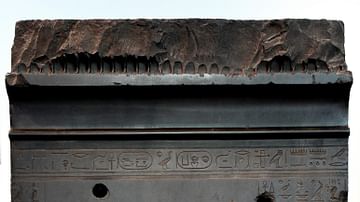
Screen Slab of King Nectanebo I
This slab enclosed a sacred spot in the temple of Atum, a creator god, Heliopolis. King Nectanebo I is shown kneeling and making offerings. In this scene, he presents a loaf of bread. On the other side (now damaged), he appeared in the company...
Definition
Uat-Ur
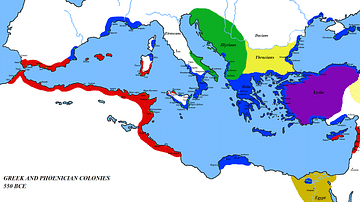
Uat-Ur was the ancient Egyptian name for the Mediterranean Sea (also known as Wadj-Wer) and is translated as 'the Great Green'. Uat-Ur was understood as a living entity imbued with the spirit of the divine which, like all other aspects of...
Image
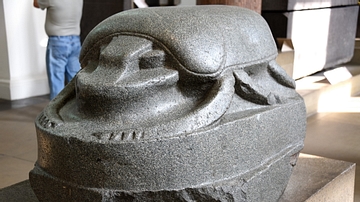
Colossal Scarab
This is one of the largest representations of scarab beetles to survive. It also ranks among the last great statues of any pharaonic deity. The scarab represented Khepri, the form assumed by the sun-god at dawn. The Egyptians noticed that...
Image
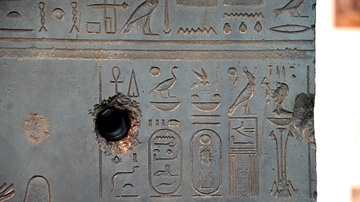
Detail of the Screen Slab of King Nectanebo I
This detail shows the cobra goddess Wadjyt empowering king Nectanebo I, who is represented by his Horus name and cartouches. A pharaoh had five official names; this panel, shows the most important three. The Horus name identifies the king...
Image
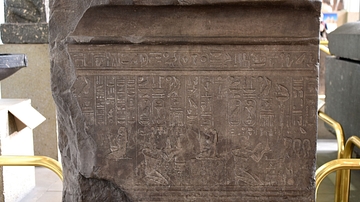
Screen Slab of King Psamtek I
On this side, Psamtek (Psamtik) I kneels making offerings to fearsome-looking deities, including a double-headed bull god and a snake. The majority hold long knives, as they were meant to guard a sacred space located behind this wall. Most...
Image
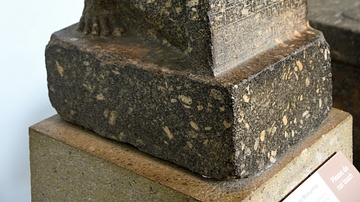
Statue of Governor Montuemhat
Montuemhat kneels behind a stela, raising his hands in worship. The damaged top left of the stela shows him likewise, adorning the sun-god Atum-Khepri. A hymn below describes Atum's sunset into the netherworld. A matching statue, now in Cairo...

Article
Music & Dance in Ancient Egypt
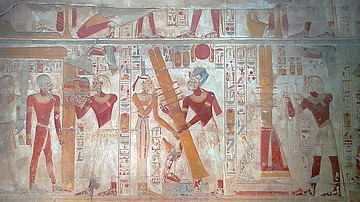
Music and dance were highly valued in ancient Egyptian culture, but they were more important than is generally thought: they were integral to creation and communion with the gods and, further, were the human response to the gift of life and...
Article
The Forty-Two Judges
The Forty-Two Judges were divine entities associated with the afterlife in ancient Egypt and, specifically, the judgment of the soul in the Hall of Truth. The soul would recite the Negative Confession in their presence as well as other gods...

Article
The Battle of Kadesh & the Poem of Pentaur
The Poem of Pentaur is the official Egyptian record (along with The Bulletin) of the military victory of Ramesses II (known as The Great, 1279-1213 BCE) over the Hittite King Muwatalli II (1295-1272 BCE) at the Battle of Kadesh in 1274 BCE...
