
Search
Did you mean: Utica?
Remove Ads
Advertisement
Search Results

Definition
Eleusis
Eleusis was a deme of Athens and most famous for its annual festival of the Mysteries in honour of Demeter and Persephone. The site was also an important fortress protecting Attica and held several other important festivals, notably...
Definition
Ino
Ino is a princess of Thebes and the wife of King Athamas of Boeotia in Greek mythology. She helped to raise Dionysos, the god of wine, but the most famous myth associated with her is her descent into madness and the tragic fate of her family...

Definition
The Pentecontaetia
The Pentecontaetia (Pentekontætia, πεντηκονταετία) or “the account of the fifty years” is a term first used by Thucydides to describe, in Book 1, Sections 89 to 117 (1.89-117) of his History of the Peloponnesian War, the period...
Image
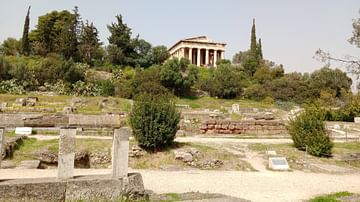
The Temple of Hephaestus, Ancient Agora of Athens
The temple, known as the Theseion, is located in the Ancient Agora of Athens, Greece. The temple's construction began in 449 BCE. It was built in honor of two gods, Hephaestus and Athena.

Article
Temple of Athena Nike
The Temple of Athena Nike, on the southwest bastion of the Acropolis, is smaller than the other buildings behind it but no less impressive. It was completed in 420 BCE during the restoration of Athens after the Persian invasion...

Article
A Visual Glossary of Greek Pottery
Alabastron (pl. alabastra) - a small jar for storing perfumes, named after the material (alabaster) the first examples were made from. They were often carried by a string looped around the neck of the vessel. Amphora...

Article
The Greek Strategy at the Battle of Salamis 480 BCE
The history of the second Persian war as presented in most of the modern literature is solely based on Herodotus' Histories. However, Herodotus' narration seems to contain several unrealistic elements...

Article
Roman Students in Athens
Training in oratory was a crucial part of Roman education; it was associated with a young boy's transition into adult life. As Athens was considered the intellectual centre of the eastern Mediterranean, many students undertook...
Article
Pausanius' Guide To Ancient Athens
Pausanius (l. 110-180 CE) was a geographer and historian who traveled extensively, taking notes on points of interest, then wrote on them in guide books which could be used by tourists visiting the sites described...
Article
The Battle of Chaeronea in Diodorus Siculus
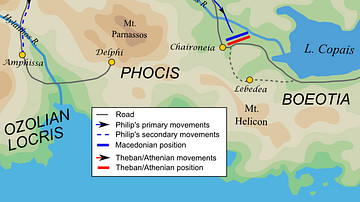
Chaeronea is the site of the famous Battle of Chaeronea (338 BCE) Phillip II of Macedon's decisive defeat of the Greek city-states. At Chaeronea in Boeotia (north of Corinth) Phillip and his allies from Thessaly...
