
Search
Remove Ads
Advertisement
Search Results

Definition
Heiankyo
Heiankyo (Kyoto), located in the centre of Honshu island, was the capital of Japan for over a thousand years and gave its name to one of the golden ages of Japanese history, the Heian Period (794-1185 CE). Built according to Chinese...
Definition
Ryoanji
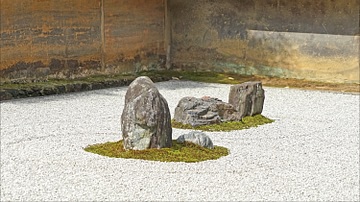
Ryoanji (Ryōan-ji) is a Zen Buddhist temple in Kyoto, Japan which is today most famous for its Zen rock garden with its enigmatic arrangement of stones. Founded in the 15th century CE, the temple is one of the most visited tourist spots...

Article
Daily Life in Medieval Japan
Daily life in medieval Japan (1185-1606 CE) was, for most people, the age-old struggle to put food on the table, build a family, stay healthy, and try to enjoy the finer things in life whenever possible. The upper classes...

Article
Tea in Ancient China & Japan
Tea, still probably the world's most popular prepared beverage, was first drunk by Chinese monks to aid meditation and those who valued its medicinal qualities, but it quickly grew in popularity, spreading to other East...

Article
The History of Japanese Green Tea
The history of green tea in Japan goes back to the 8th century when it was a popular stimulant for meditating monks. In this article, we examine tea's origins and cultivation, how it became an integral part of Japanese...

Image
Togudo Hall, Ginkaku-ji
The Togudo Hall, Ginkaku-ji. It was originally the private residence of the retired shogun Ashikaga Yoshimasa (l. 1436-1490 CE, r. 1449-1474 CE). Built in the late 15th century CE, the hall contains the oldest surviving...

Image
Kinkakuji Temple in Kyoto, Japan
Kinkakuji Temple or the "Temple of the Golden Pavilion" was constructed in the 1390s CE as the retirement villa for Shogun Ashikaga Yoshimitsu (r. 1368–1394 CE). It is comprised of a three-story pavilion — covered...
Image
Side View of Kinkakuji Temple
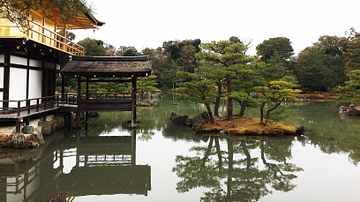
Kinkakuji Temple or the "Temple of the Golden Pavilion" was constructed in the 1390s CE as the retirement villa for Shogun Ashikaga Yoshimitsu (r. 1368–1394 CE). While Japan suffered warfare, plague, deteriorating economic...
Image
Miniature Stone Pagoda at Kinkakuji Temple
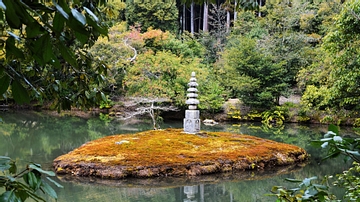
Kinkakuji Temple or the "Temple of the Golden Pavilion" was constructed in the 1390s CE as the retirement palace for Shogun Ashikaga Yoshimitsu (r. 1368–1394 CE). It is surrounded by the waters of a calm pond...

Image
Kyoto's Kinkakuji Temple Compound
Kinkakuji Temple or the "Temple of the Golden Pavilion" was constructed in the 1390s CE as the retirement palace for Shogun Ashikaga Yoshimitsu (r. 1368–1394 CE). It is surrounded by the waters of a calm pond, tea...
