
Search
Remove Ads
Advertisement
Search Results
Definition
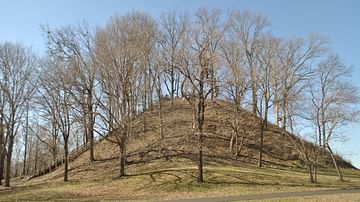
Pinson Mounds
The Pinson Mounds are a State Archeological Park in Madison County, Tennessee, USA enclosing a prehistoric Native American religious site comprising earthen mounds built during the Middle Woodland Period (c. 200 BCE - 500 CE). Although...

Article
Cuneiform Lexical Lists
Lexical lists are compilations of cuneiform signs and word readings written on clay tablets throughout Mesopotamia. From the late 4th millennium BCE up to the 1st century CE, scribal communities copied, modified, and passed...

Definition
Ancient Greece
Greece is a country in southeastern Europe, known in Greek as Hellas or Ellada, and consisting of a mainland and an archipelago of islands. Ancient Greece is the birthplace of Western philosophy (Socrates, Plato, and Aristotle...

Article
Hei Tiki
The hei tiki is a small personal adornment, fashioned by hand from tough pounamu (New Zealand greenstone or nephrite jade), and is worn around the neck. Hei means something looped around the neck, and tiki is a generic word used throughout...

Article
Sicilian Temples (Greek Metrology)
Characteristics of Sicilian Archaic Temples The large dimensions of the components, the presence of a propteron, an adyton, and other specific elements of the plan and elevation speak for an originally very autonomous...

Definition
Cyclades
The Cyclades are a group of islands in the southern Aegean situated between the Greek mainland and Turkey. The name was coined in the Archaic period as the islands form an approximate circle (kyklos) around the central and most sacred...
Article
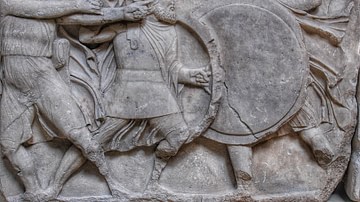
The Grand Strategy of Classical Sparta
In ancient Lacedaemon, as in all enduring political communities, there was a symbiotic relationship between the form of government chosen, the way of life that this form of government fostered, and the grand...

Definition
Cleobis and Biton
Two over-life-size Archaic kouroi (6.5 ft / 2 m) are housed at the Delphi Museum, and date to c. 580 BCE. Their names (Cleobis and Biton) are actually written on their bases, and the sculptor is given as Polymides of Argos: such...

Definition
Mycenaean Civilization
The Mycenaean civilization flourished in the Late Bronze Age (c. 1700-1100 BCE), peaking from the 15th to the 13th century BCE. The Mycenaeans extended their influence throughout the Peloponnese in Greece and across the Aegean...

Image
Kouroi by Polymedes
Twin Kouroi of Argos - named Kleobis and Biton - sculpted by Polymedes (c 580 BCE), mature archaic style. Delphi Archaeological Museum, Greece.
