
Search
Did you mean: Anjar?
Remove Ads
Advertisement
Search Results

Article
Pausanius' Guide To Ancient Athens
Pausanius (l. 110-180 CE) was a geographer and historian who traveled extensively, taking notes on points of interest, then wrote on them in guide books which could be used by tourists visiting the sites described...

Article
Xenophon's Defense of Socrates
Xenophon's Defense of Socrates (c. 371 BCE) is a passage from the Memorabilia of Xenophon (l. 430 to c. 354 BCE) in which he addresses the teachings and actions of Socrates of Athens and denounces the charges against...

Article
Roger Williams' The Bloody Tenent of Persecution
The Bloody Tenent of Persecution (original title, The Bloody Tenenent of Persecution for Cause of Conscience) is a 1644 CE book by the Puritan separatist Roger Williams (l. 1603-1683 CE) which is best...

Article
Top 10 Sights along Hadrian's Wall
The 1,900th anniversary of the visit of the Roman emperor Hadrian (r. 117-138 CE) to Britain and the construction of the wall that bears his name will be observed in 2022. A year-long festival will be held, filled...

Article
The Ancient Concept of a Noble Death
The act of voluntary death was never condemned in antiquity. In fact, The English word "suicide" comes from the Latin for "self-slaying." The reason for a voluntary death had to be one that was honorable and necessary...
Article
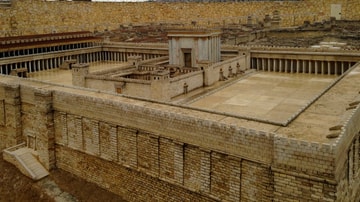
The Temple in Jerusalem
According to Jewish tradition, the original Jerusalem Temple was ordained by Yahweh/God, as described in 2 Samuel 7:12, where Yahweh commands Nathan to tell David: When your days are fulfilled and you lie down with your...

Image
Ganymede with the Eagle of Zeus
This statue came from Italy. Set on a Roman funerary altar with Latin inscription for "Ti Cl Corinthus." The altar was found near Porta Capena at Rome in 1713 CE and acquired by General Sir H. J. Montresor, circa 1750...

Image
Main Carving, Rock-Cut Tombs of Qizqapan
This is the main scene, carved between the engaged Iranian ionic-style columns and above the entrance into the main chamber of the rock-cut tombs of Ashkawt-i Qizqapan (Kurdish: The Cave of the Ravisher or...
Image
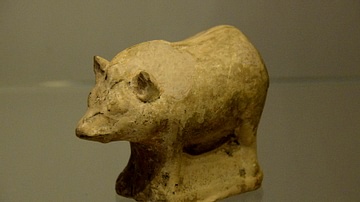
Roman Votive Boar, Burnswark
This small boar was an offering to a god. Offerings were made on the hollow on the top of an altar (wine was often poured onto the altar). The idea of a contract between human beings and gods was central to Roman religious...
Image
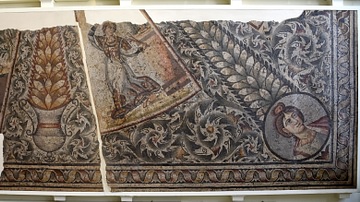
Seasons Mosaic, Carthage
The figure of March on this fragment of floor mosaic stands pointing at a swallow in a tree behind an altar. April holds a pair of castanets, dancing in front of an altar of Venus. From Carthage, modern-day Tunisia. Second...
