
Search
Remove Ads
Advertisement
Search Results
Image
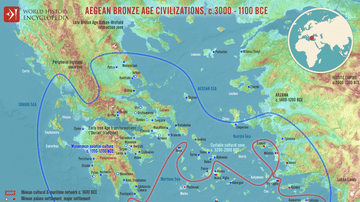
Map of the Aegean Bronze Age Civilizations, c. 3000-1100 BCE - From Minoan Maritime Exchange to Mycenaean Dominance
The Aegean world of the Bronze Age (c. 3000–1100 BCE) was shaped by shifting centers of power, interaction, and cultural exchange, most notably between...

Video
Mask of Agamemnon: Schliemann's Discovery
A short video describing Heinrich Schliemann's discovery of the so-called "Death Mask of Agamemnon".

Video
What the Discovery of the Last American Slave Ship Means to Descendants | National Geographic
In this short film, the descendants of Africans on the last known American slave ship, Clotilda, describe what it would mean to discover and document the wreck site...

Video
How discovery of the slave ship Clotilda informs U.S. history
The remains of the last slave ship that came to America have been found. In 1860, the schooner Clotilda brought 110 Africans to U.S. shores, decades after it was illegal to import slaves into...

Article
Lost Civilisations of Anatolia: Göbekli Tepe
Göbekli Tepe is the world's oldest example of monumental architecture; a 'temple' built at the end of the last Ice Age, 12,000 years ago. It was discovered in 1995 CE when, just a short distance from the...

Image
Map of the Late Bronze Age Collapse and Transfromation - Interconnected political, economic & environmental breakdown
The Late Bronze Age Collapse and Transformation (c. 1250–1100 BCE) was a period of major political, economic, and social disruption across the Aegean...

Image
Map of India in the Vedic Age, 1500 BCE-500 BCE - Indo-Aryan Cultures in Northern India
The Vedic Age (c. 1500-500 BCE) marks a formative period in the history of the northern Indian subcontinent, bridging the decline of the Indus Valley Civilization (c. 1300...

Image
Map of the Iron Age La Tène Culture c.400 BCE - c.50 CE
This map illustrates the extent of the La Tène culture, a key phase of the European Iron Age that flourished from around 450 BCE until the Roman conquests in the 1st century BCE. It highlights the...
Image
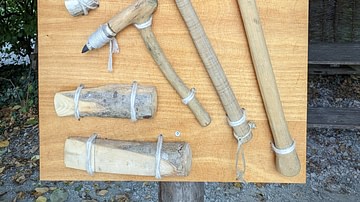
Stone Age Tools (Modern Recreations)
A collection of modern recreations of Stone Age tools. The picture above shows (from top right to bottom left): - A hatchet with a wing spar, used for felling trees - A straight hatchet for shortening smaller...
Image
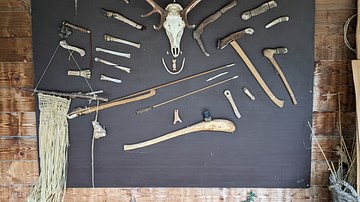
Stone Age Tools Made From Antlers
Modern recreations of Stone Age tools: knives, arrows, hatchets, axes, and daggers, made of deer antlers.
Pile-Dwelling Museum in Unteruhldingen at Lake Constance, Germany.
