
Search
Remove Ads
Advertisement
Search Results

Definition
Greek Mythology
Greek mythology was used as a means to explain the environment in which humankind lived, the natural phenomena they witnessed and the passing of time through the days, months, and seasons. Greek myths were also intricately connected to religion...
Image
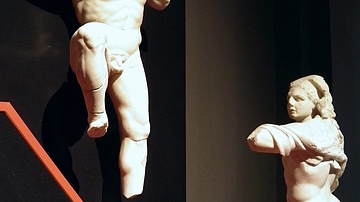
Liberation of Prometheus by Heracles
Statue group depicting the liberation of Prometheus by the Greek hero Heracles. Prometheus is freed from the eagle's torment. Found in the North Hall of the Athena Terrace at Pergamon (Turkey). Dated to 100 BCE. (Pergamon Museum, Berlin)
Definition
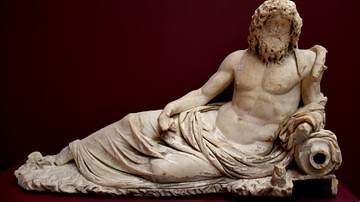
Oceanus
Oceanus (also Okeanos) was the eldest of the Titans and a son of Uranus (Heaven) and Gaia (Earth) in Greek mythology. He was the god and personification of the freshwater river Oceanus, which was thought to encircle the earth and was said...

Definition
Theogony
The Theogony is an 8th-century BCE didactic and instructional poem, credited to the Greek poet Hesiod. The Theogony was, at first, not actually written down, rather, it was part of a rich oral tradition which only achieved written form decades...

Definition
Works and Days
Works and Days is an epic poem written in dactylic hexameter, credited to the 8th-century BCE Greek poet Hesiod. Hesiod is generally remembered for two epic works, Theogony and Works and Days but, like his contemporary Homer, he was part...
Definition
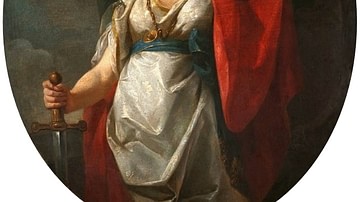
Themis
Themis is the personification and goddess of divine law, will, and justice in Greek mythology. She was held in high esteem by the Olympians, often sitting by Zeus' throne and giving him wise counsel. Themis held the place of Oracle at Delphi...

Definition
Pandora
Pandora is a figure from Greek mythology who was not only the first woman, but —as an instrument of the wrath of Zeus— was held responsible for releasing the ills of humanity into the world. Pandora was also an unrelated earth goddess in...

Article
Hesiod on the Birth of the Gods
The Greek poet Hesiod (c. 700 BCE) is most famous for his works Theogony and Works and Days. In this passage from Theogony, Hesiod relates the birth of the gods from cosmic Chaos and follows the lineage through the great Zeus, King of the...

Definition
Hesiod
Hesiod (c. 700 BCE) in conjunction with Homer, is one of those almost legendary early Greek Epic poets. His works are not of comparable length to Homer's. Hesiod's poems are not epic because of their length, but because of their language...

Definition
Mythology
Myths are a part of every culture in the world and are used to explain natural phenomena, where a people came from and how their civilization developed, and why things happen as they do. At their most basic level, myths comfort by giving...
