
Search
Remove Ads
Advertisement
Search Results

Definition
Statue of Zeus at Olympia
The monumental statue of Zeus at Olympia in Greece was one of the Seven Wonders of the Ancient World. Created in the 430s BCE under the supervision of the master Greek sculptor Phidias, the huge ivory and gold statue was bigger even than...

Definition
Ares
Ares was the Greek god of war. He was perhaps the most unpopular of all the Olympian gods because of his quick temper, aggressiveness, and unquenchable thirst for conflict. Ares famously seduced Aphrodite, unsuccessfully fought with Hercules...

Video
Greek Mythology Family Tree: Primordials, Titans & Olympians
A guide to the genealogy of Greek gods and goddesses. CREDITS: Chart: Matt Baker Script/Narration: Matt Baker Animation: Syawish Rehman Audio Editing: Jack Rackham Intro music: "Lord of the Land" by Kevin MacLeod and licensed under...
Image
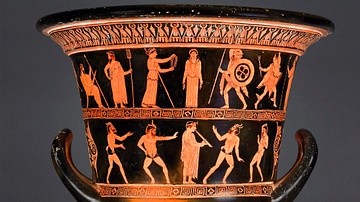
Pandora Vase
Red-figure calyx-krater (mixing jar), c. 460-450 BCE, painted in Attica, Greece, and found in Altamura, Italy, attributed to The Niobid Painter. The Pandora Vase is named after the top frieze of side A, which shows the creation of Pandora...

Article
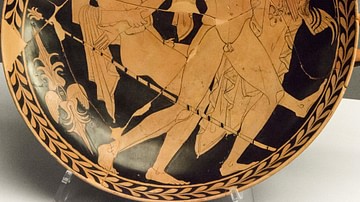
The Plays of Cratinus
Cratinus was a highly successful writer of Attic Old Comedy, but the very fragmentary nature of his surviving plays means that he is not as well remembered as Aristophanes (eleven of whose plays come down to us intact). Despite this, it is...
Definition
Ganymede
Ganymede (pronounced GAH-nuh-meed) is a youth in Greek mythology who is abducted by Zeus because of his great beauty and brought to Mount Olympus to serve as cupbearer. The story first appears in Homer’s Iliad without any suggestion of a...

Definition
Parthenon
The magnificent temple on the Acropolis of Athens, known as the Parthenon, was built between 447 and 432 BCE in the Age of Pericles, and it was dedicated to the city's patron deity Athena Parthenos. The temple was constructed to house the...

Article
Warrior Women of the World of Ancient Macedon
The 8th November is celebrated as Archangels Day in Greece, but on that November day in 1977 CE something remarkable happened: an excavation team led by Professor Manolis Andronikos were roped down into the eerie gloom of an unlooted Macedonian-styled...
Article
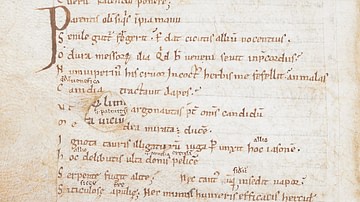
Horace's Epodes
Horace's Epodes is a book of 17 poems, published around 30-29 BCE. It contains many of the earliest poems of Quintus Horatius Flaccus, better known as Horace (65-8 BCE); some were written before his acquaintance with Maecenas, patron of the...

Image
Temple of Hephaistos & Athena, Athens
Also known as the Theseum because of its decorative sculpture depicting the feats of Theseus, the Doric temple, built in 449 BCE, is situated in the agora of Athens. Hephaistos and Athena, as gods of crafts were worshipped here and within...
