
Search
Remove Ads
Advertisement
Search Results

3D Image
Hagia Sophia 537 CE
Reconstruction of the Hagia Sophia in Constantinople at its inauguration, December 27th 537 CE. To create this model, some artistic liberty was required. However, there is some documentation on which parts of the building were added or removed...

Article
Discovery of Troy
In his epic poems, the Iliad and the Odyssey, the Greek poet Homer (c. 750 BCE) told the story of the Trojan War, a ten-year siege of the city of Troy by an alliance of Greek city-states. Troy was also known by its Latinised name of Ilium...

Definition
Jan Žižka
Jan Žižka (l. c. 1360 – 1424) was a Czech general and one of the most brilliant tacticians in military history. In the Hussite Wars (1419 to c. 1434), he was undefeated as the leader of the Hussites against the Catholic loyalists. Even completely...

Definition
Ivan III of Russia
Ivan III of Russia (Ivan the Great) was the Grand Prince of Moscow and Russia from 1462 to 1505. Ivan III was born in 1440 to Grand Prince Vasily II of Moscow (r. 1425-1462) and his wife, Maria Borovsk (l. c. 1420-1485). He served as co-ruler...
Article
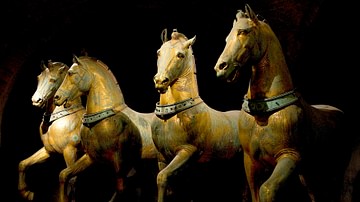
The Hippodrome of Constantinople
The Hippodrome of Constantinople was an arena used for chariot racing throughout the Byzantine period. First built during the reign of Roman emperor Septimius Severus in the early 3rd century CE, the structure was made more grandiose by emperor...

Article
1453: The Fall of Constantinople
The city of Constantinople (modern Istanbul) was founded by Roman emperor Constantine I in 324 CE and it acted as the capital of the Eastern Roman Empire, or Byzantine Empire as it has later become known, for well over 1,000 years. Although...
Image
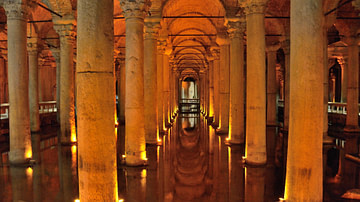
Columns of Basilica Cistern, Istanbul
Located across the Hagia Sophia Museum, Yerebatan Sarayi is also known as the Basilica Cistern because of a basilica that was once located nearby as a cultural centre. It is the largest surviving underground cistern of Istanbul. Fatih Cistern...

Definition
Mystras
The city of Mystras (or Mistras) in southern Greece was the provincial capital of the Byzantine Despotate of the Morea from the 13th through the 15th centuries CE. It was founded in 1249 CE by William II of Villehardouin, and it served as...

Definition
Saint Cyril
Saint Cyril (aka Kyrillos and Constantine the Philosopher, d. 867 CE) was a Byzantine linguist, teacher, scholar and missionary who famously preached Christianity to the Slavs in Moravia with his brother Methodius during the 9th century CE...

Definition
Basil II
Basil II (aka Basilius II) was the emperor of the Byzantine Empire from 976 to 1025 CE. He became known as the Bulgar-Slayer (Bulgaroktonos) for his exploits in conquering ancient Bulgaria, sweet revenge for his infamous defeat at Trajan's...
