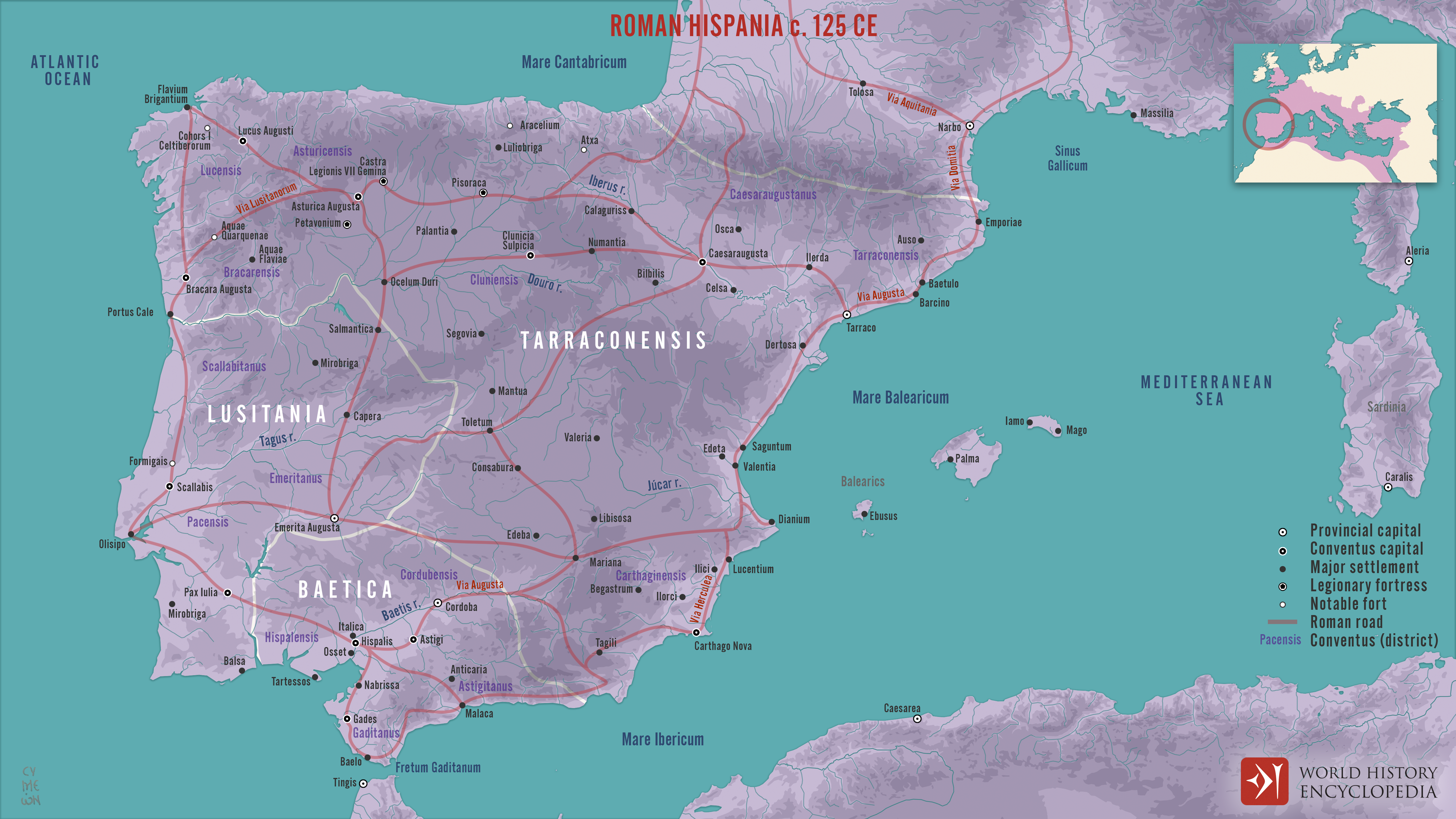
Map of Roman Hispania c. 125 CE

The Roman provinces in Hispania (206 BCE–c. 474 CE) illustrate both the persistence of Roman expansion and the durability of imperial rule. The conquest began in the Second Punic War, when Rome displaced Carthage in 206 BCE, and unfolded over nearly two centuries as legions subdued Iberian and Celtiberian peoples. By the reign of Augustus (27 BCE–14 CE), the peninsula was reorganized into formal provinces, with Hispania Tarraconensis, Baetica, and Lusitania forming the core. These regions supplied the empire with silver, gold, olive oil, and grain, while also serving as a recruiting ground for Roman armies.
Over the following five centuries, Hispania became one of the most thoroughly Romanized areas of the West. Cities like Emerita Augusta (Mérida), Italica, and Tarraco flourished with theaters, aqueducts, and forums, while Latin language, Roman law, and Christianity took deep root. Hispania produced notable emperors, including Trajan (98–117 CE) and Hadrian (117–138 CE). Even as the Western Empire crumbled in the 5th century, northeastern Hispania remained under nominal Roman control until c. 474 CE, outlasting many other provinces and leaving a legacy of cultural and institutional continuity that shaped medieval Iberia.