
Search
Remove Ads
Advertisement

 This answer was generated by
 Search Results

Article
Bureaucracy in the Achaemenid Empire: Learning from the Past
In the early days of the Achaemenid Empire (c. 550-330 BCE), the kings came to realise that, if they were to be able to administer the vast mass of land and the multicultural people who inhabited...

Definition
Old Kingdom of Egypt - The Age of the Pyramids
The Old Kingdom of Egypt (circa 2613-2181 BCE) is also known as the "Age of the Pyramids" or "Age of the Pyramid Builders" as it includes the great 4th Dynasty when King Sneferu perfected the art of pyramid...

Definition
Assyria
Assyria was the region located in the ancient Near East which, under the Neo-Assyrian Empire, reached from Mesopotamia (modern-day Iraq) through Asia Minor (modern Turkey) and down through Egypt. The empire began modestly at the city...

Definition
Emperor of Japan
The emperor of Japan is a position as the head of state which traditionally dates back to the 7th century BCE and the legendary figure of Emperor Jimmu (r. 660-585 BCE). Emperors came to be known as the Tenno or 'heavenly sovereign'...

Definition
Yongle Emperor
The Yongle Emperor (aka Chengzu or Yung Lo, r. 1403-1424 CE) was the third ruler of the Chinese Ming Dynasty (1368-1644 CE). Inheriting a stable state thanks to the work of his father, the Hongwu Emperor (r. 1368-1398 CE), Yongle...

Article
The Civil Service Examinations of Imperial China
The civil service examinations of Imperial China allowed the state to find the best candidates to staff the vast bureaucracy that governed China from the Han Dynasty onwards (206 BCE - 220 CE). The exams...

Article
Reforms of Augustus
Emperor Augustus (27 BCE – 14 CE) accomplished much during his time on the Roman throne, far more than many of his successors. According to historian Mary Beard in her book SPQR, he transformed the structures of Roman Empire...

Article
Eunuchs in Ancient China
Eunuchs were powerful political players in ancient Chinese government. Originating as trusted slaves in the royal household they were ambitious to use their favoured position to gain political power. Advising the emperor...

Article
Police in Ancient Egypt
In any society, members of the community recognize they are required to restrain certain impulses in order to participate in the community. Every civilization has had some form of law which makes clear that the benefits...
Article
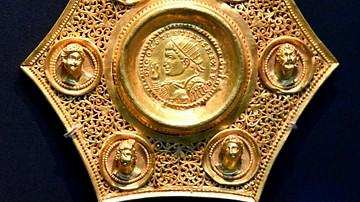
Government and Taxes under Diocletian and Constantine
The state created by Diocletian and Constantine used to be described as despotic and oppressive, extracting higher taxes and threatening its subjects with punishments for non-compliance. Recent research...
