
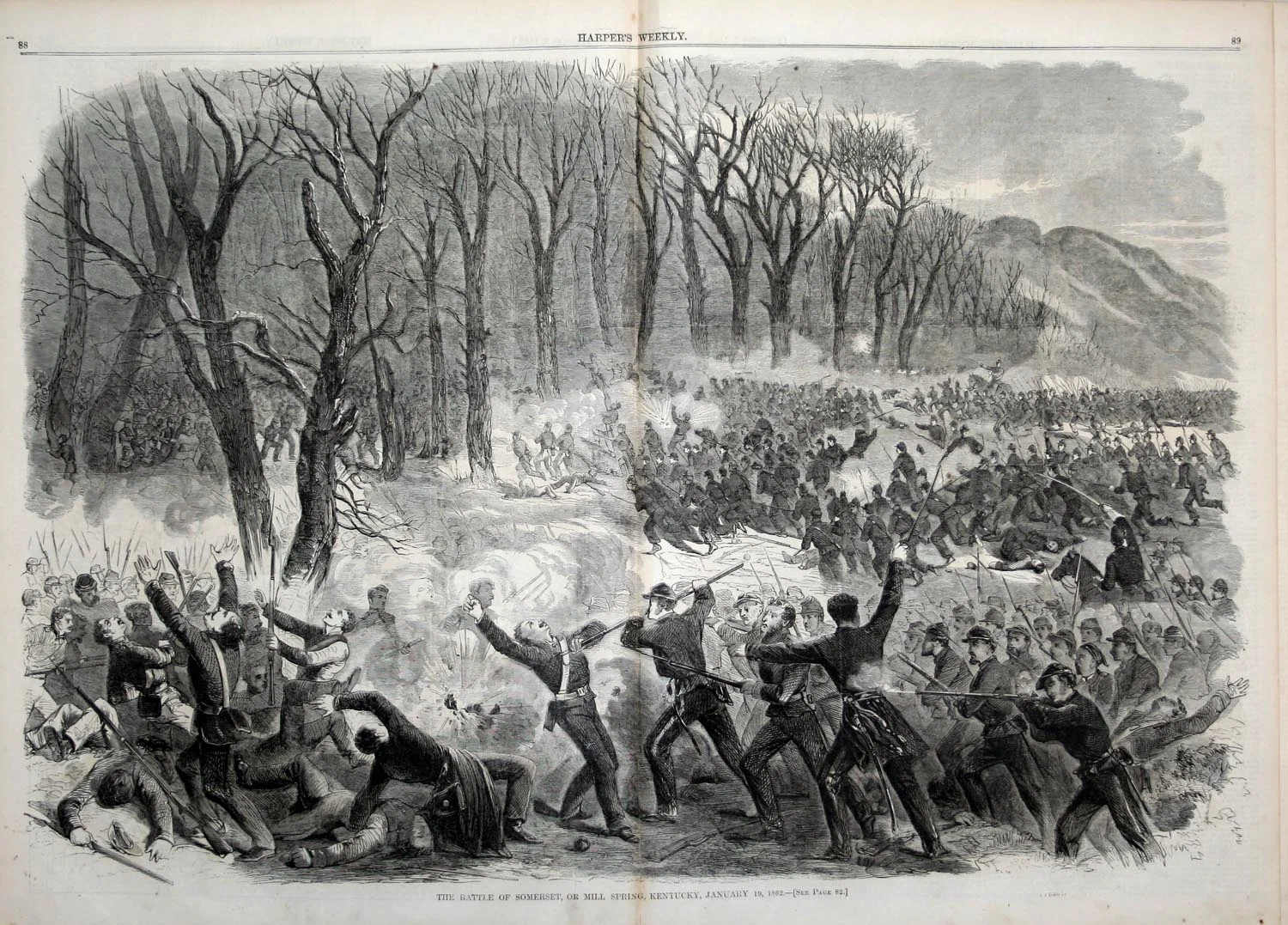
At the Battle of Mill Springs (19 January 1862) in Kentucky, Union Brigadier General George H. Thomas had originally planned to strike first, advancing from Logan's Crossroads to launch an assault on the Confederate encampment at Beech Grove near the Cumberland River, ten miles (16 km) from his position.
Thomas's plan was preempted by Confederate Brigadier General Felix Zollicoffer's advance, beginning just before midnight on the 18th, which was intended to catch Thomas's forces by surprise. The bad weather, and poor condition of the roads, slowed Zollicoffer's march and the element of surprise was lost.

Even so, Thomas awoke the morning of the 19th to find the Confederate forces in front of him instead of miles away at Beech Grove. Thomas had planned the battle carefully, however, and so, instead of panicking, as another general might, he held to his original plan. Whether the enemy was in front of him or miles away, the plan was still sound. Thomas had thrown out pickets far in advance of his position upon his arrival (who had alerted the army to the Confederate advance), and his defensive perimeter was strong and well anchored.
Confident in his plan, Thomas methodically ordered reinforcements to fill gaps where needed or support threatened positions. Reinforced by Brigadier General Albin F. Schoepf, Thomas ordered a push against the Confederate line on both flanks and a bayonet charge by the 9th Ohio on the Confederate left flank. Scholar Stuart W. Sanders describes the charge:
The 9th Ohio pushed the Confederate left flank past the cabin where the pickets of the 10th Indiana has been posted. They then drove them southward several hundred more yards to a Confederate hospital site. Seeing cavalry operating on their flanks, the Ohioans stopped and prepared for a charge by forming a hollow square.
(100)
This broke the Confederate lines, and they fled the field in a rout.
The Battle of Mill Springs became the first Union victory in the Western theater of the American Civil War, opening up East Tennessee to Union troops, allowing for Ulysses S. Grant to mount his attacks on Fort Henry and Fort Donelson in February of 1862 (both Union victories), and maintaining Kentucky as a neutral border state throughout the war. Sanders writes:
As Eastham Tarrant of the 1st Kentucky Cavalry wrote, the battle "was one of the most brilliant victories to the Union cause, and one of the most important in its results that happened during the war. It was its first great victory. It revived the drooping spirits of the loyalists throughout the United States and spread consternation in the ranks of the heretofore audacious foe.
It contradicted the extravagant assertions…that one valiant Southerner was equal to five Yankees on the field of battle…it was the forerunner of a series of successful movements and brilliant victories of the Union armies which not only caused the enemy to abandon Kentucky in force, but also the largest portion and most fertile regions of Tennessee."
(125)
Text
On 31 January 1862, General Thomas wrote his action report on the battle for the Union authorities. This report, along with many others – from both Confederate and Union generals – are preserved in the Official Records of the Union and Confederate Armies in the War of the Rebellion. Thomas's account comes from Series I, Volume 7.
The following excerpt from that account is taken from the article General George Thomas' Account of the Battle of Mill Springs, or Logan's Crossroads, Kentucky by Mark (no last name given) from the site Iron Brigader: Civil War Info and Resources.
HDQRS. FIRST DIVISION DEPARTMENT OF THE OHIO
Somerset, Ky., January 31, 1862I have the honor to report that in carrying out the instructions of the general commanding the department, contained in his communication of the 29th of December, I reached Logan's Cross-Roads, about 10 miles north of the intrenched camp of the enemy on the Cumberland River, on the 17th instant, with a portion of the Second and Third Brigades, Kenny's battery of artillery, and a battalion of Wolford's cavalry.
The Fourth and Tenth Kentucky, Fourteenth Ohio, and the Eighteenth U.S. Infantry being still in rear, detained by the almost impassable condition of the roads, I determined to halt at this point, to await their arrival and to communicate with General Schoepf.
The Tenth Indiana, Wolford's cavalry, and Kenny's battery took position on the road leading to the enemy's camp. The Ninth Ohio and Second Minnesota (part of Colonel McCook's brigade) encamped three-fourths of a mile to the right, on the Robertsport road.
Strong pickets were thrown out in the direction of the enemy beyond where the Somerset and Mill Springs road comes into the main road from my camp to Mill Springs, and a picket of cavalry some distance in advance of the infantry
General Schoepf visited me on the day of my arrival, and, after consultation, I directed him to send to my camp Standart's battery, the Twelfth Kentucky, and the First and Second Tennessee Regiments, to remain until the arrival of the regiments in rear.
Having received information on the evening of the 17th that a large train of wagons with its escort were encamped on the Robertsport and Danville road, about 6 miles from Colonel Steedman's camp, I sent an order to him to send his wagons forward under a strong guard, and to march with his regiment (the Fourteenth Ohio) and the Tenth Kentucky (Colonel Harlan), with one day's rations in their haversacks, to the point where the enemy were said to be encamped, and either capture or disperse them.
Nothing of importance occurred from the time of our arrival until the morning of the 19th, except a picket skirmish on the night of the 17th. The Fourth Kentucky, the battalion of Michigan Engineers, and Wetmore's battery joined on the 18th.About 6.30 o'clock on the morning of the 19th the pickets from Wolford's cavalry encountered the enemy advancing on our camp, retired slowly, and reported their advance to Col. M.D. Manson, commanding the Second Brigade. He immediately formed his regiment (the Tenth Indiana) and took a position on the road to await the attack, ordering the Fourth Kentucky (Col. S.S. Fry) to support him, and then informed me in person that the enemy were advancing in force and what disposition he had made to resist them.
I directed him to join his brigade immediately and hold the enemy in check until I could order up the other troops, which were ordered to form immediately and were marching to the field in ten minutes afterwards. The battalion of Michigan Engineers and Company A, Thirty-eighth Ohio (Captain Greenwood), were ordered to remain as guard to the camp.
Upon my arrival on the field soon afterwards, I found the Tenth Indiana formed in front of their encampment, apparently awaiting orders, and ordered them forward to the support of the Fourth Kentucky, which was the only entire regiment then engaged.
I then rode forward myself to see the enemy's position, so that I could determine what disposition to make of my troops as they arrived. On reaching the position held by the Fourth Kentucky, Tenth Indiana, and Wolford's cavalry, at a point where the roads fork leading to Somerset, I found the enemy advancing through a corn field and evidently endeavoring to gain the left of the Fourth Kentucky Regiment, which was maintaining its position in a most determined manner.
I directed one of my aides to ride back and order up a section of artillery and the Tennessee brigade to advance on the enemy's right, and sent orders for Colonel McCook to advance with his two regiments (the Ninth Ohio and Second Minnesota) to the support of the Fourth Kentucky and Tenth Indiana.
A section of Captain Kenny's battery took a position on the edge of the field to the left of the Fourth Kentucky and opened an efficient fire on a regiment of Alabamians, which were advancing on the Fourth Kentucky.Soon afterwards, the Second Minnesota (Col. H. P. Van Cleve) arrived, the colonel reporting to me for instructions. I directed him to take the position of the Fourth Kentucky and Tenth Indiana, which regiments were nearly out of ammunition. The Ninth Ohio, under the immediate command of Major Kammerling, came into position on the right of the road at the same time.
Immediately after these regiments had gained their position, the enemy opened a most determined and galling fire, which was returned by our troops in the same spirit, and for nearly half an hour the contest was maintained on both sides in the most obstinate manner.At this time, the Twelfth Kentucky (Col. W. A. Hoskins) and the Tennessee brigade reached the field to the left of the Minnesota regiment and opened fire on the right flank of the enemy, who then began to fall back. The Second Minnesota kept up a most galling fire in front, and the Ninth Ohio charged the enemy on the right with bayonets fixed, turned their flank, and drove them from the field, the whole line giving way and retreating in the utmost disorder and confusion.
As soon as the regiments could be formed and refill their cartridge-boxes, I ordered the whole force to advance. A few miles in rear of the battlefield a small force of cavalry was drawn up near the road, but a few shots from our artillery (a section of Standart's battery) dispersed them, and none of the enemy were seen again until we arrived in front of their intrenchments.
As we approached their intrenchments, the division was deployed in line of battle and steadily advanced to the summit of the hill at Moulden's. From this point, I directed their intrenchments to be cannonaded, which was done until dark by Standart's and Wetmore's batteries. Kenny's battery was placed in position on the extreme left at Russell's house, from which point he was directed to fire on their ferry, to deter them from attempting to cross.
On the following morning, Captain Wetmore's battery was ordered to Russell's house, and assisted with his Parrott guns in firing upon the ferry. Colonel Manson's brigade took position on the left near Kenny's battery, and every preparation was made to assault their intrenchments on the following morning.
The Fourteenth Ohio (Colonel Steedman) and the Tenth Kentucky (Colonel Harlan) having joined from detached service soon after the repulse of the enemy, continued with their brigade in the pursuit, although they could not get up in time to join in the fight. These two regiments were placed in front in my advance on the intrenchments the next morning and entered first.
General Schoepf also joined me the evening of the 19th with the Seventeenth, Thirty-first, and Thirty-eighth Ohio. His entire brigade entered with the other troops.
On reaching the intrenchments, we found the enemy had abandoned everything and retired during the night. Twelve pieces of artillery, with their caissons packed with ammunition; one battery wagon and two forges; a large amount of ammunition; a large number of small-arms, mostly the old flint-lock muskets; 150 or 160 wagons, and upwards of 1,000 horses and mules; a large amount of commissary stores, intrenching tools, and camp and garrison equipage, fell into our hands.A correct list of all the captured property will be forwarded as soon as it can be made up and the property secured.
The steam and ferry boats having been burned by the enemy in their retreat, it was found impossible to cross the river and pursue them; besides, their command was completely demoralized, and retreated with great haste and in all directions, making their capture in any numbers quite doubtful if pursued.
There is no doubt but what the moral effect produced by their complete dispersion will have a more decided effect in re-establishing Union sentiments than though they had been captured.
It affords me much pleasure to be able to testify to the uniform steadiness and good conduct of both officers and men during the battle, and I respectfully refer to the accompanying reports of the different commanders for the names of those officers and men whose good conduct was particularly noticed by them….I am sir, very respectfully, your obedient servant,
Geo. H. Thomas,
Brigadier General, U.S. Volunteers, Commanding