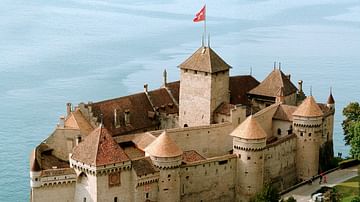

Colditz Castle in Saxony, Germany, sits high on a precipitous cliff face that towers above a tributary of the river Mulde. First built in the 11th century, the forbidding castle was variously used as a lunatic asylum, a sanatorium for the wealthy, and, through the 1930s, as a prison for enemies of Nazi Germany. In 1939, the castle took on its most famous role: a camp for Allied prisoners of war who had repeatedly attempted to escape from less secure camps. Considered escape-proof by the German army authorities who ran it, the prisoners at Colditz had other ideas, some of which were ludicrous failures, but many others were audacious successes.

Impregnable Colditz
The Colditz Castle camp opened for business in 1939 and was given the designation Offizier Lager IVC, indicating its purpose as an officer's camp. The first inmates were Polish and French officers captured as the German Army's Blitzkrieg tactics brought a string of dramatic victories in the first year of the war. As the war dragged on, many other nationalities joined the camp. Notable detainees at Colditz included the RAF ace Douglas Bader, leader of the Warsaw uprising General Tadeusz Bór-Komorowski, and founder of the SAS Lieutenant-Colonel David Stirling.
The imposing castle was certainly a good choice for a prison camp. Tunnelling out, the traditional first-choice escape method, was almost impossible since the castle was built on solid rock and sound detectors were in place. Unlike other camps, which were typically enclosed only by wire fencing that might be cut anywhere, there were very few ways in and out of the castle. The tiny windows in the prisoners' accommodation were barred, and most faced an outside drop of at least 100 feet (30 m). There was a dry moat, a high outer wall, reams of barbed wire, regular sentry posts, guard dogs, and search lights, which were continuously turned on, even during air raids. Finally, the garrison at Colditz always outnumbered the prisoners.
Even if prisoners could get out, they still found themselves 400 miles (650 km) from non-Nazi territory. It seemed very reasonable to suppose the castle actually was escape-proof. On the other hand, for Allied prisoners, escape was considered a duty, and they had nothing but time in which to cook up escape plans that ranged from the ludicrous to the sublime. Regular discoveries of escape plans and the consequent spells in solitary confinement or removal of privileges did nothing whatsoever to dampen enthusiasm for trying to get out of Colditz.

POWs were, under the terms of the Geneva Convention, meant to be housed and fed to the same standard as garrisoned troops. Correspondence was permitted with family back home. Until Heinrich Himmler banned them in 1944, Red Cross 'comfort' parcels could be sent to prisoners, although at Colditz, such parcels only ever arrived irregularly. According to the Convention, the maximum punishment for a failed escape attempt was to be no worse than one month of solitary confinement.
Successful escapes very often needed outside help. As in other POW camps, guards at Colditz could be persuaded to look the other way or provide such essentials as tools, some German money, a compass, and documents like maps and passes, which permitted the escapee to travel through German-controlled territory undetected. Forgers made unique documents, like identity cards, using stolen ones as templates. Chocolate, cigarettes, and anything else acquired via Red Cross parcels could be used for bribes. Guards might find themselves blackmailed into assisting escape attempts if they could be tricked into some sort of compromising behaviour. Sometimes guards played along only to later inform the camp commandant and foil the escape in mid-execution. Escapees had to be careful of their own side, too. Some prisoners did operate as informants to the guards, and many escape plans were wrecked in this way.
The Escapes
A medieval castle is designed to keep people out, not in. This fact, combined with the prisoners' insatiable appetite for freedom, meant that hundreds of escape attempts were made. These ranged from the impulsive 'seize-the-moment' improvisations to plans that took months to prepare. Many attempts were foiled before they ever got off the ground because of regular inspections and searches. Rash attempts to tunnel, use the sewer system, climb off the roof using a rope, or cut iron bars from windows were soon discovered because of the noise involved. An overambitious attempt to get out disguised as a woman failed. Hiding in rubbish sacks or recklessly jumping off the castle walls sometimes worked, but the guards were as experienced in the art of escaping as the prisoners. Despite all the difficulties, around 300 men did manage to escape from the castle itself.

Escaping from the castle was only half the job, of course. All men had to attend a roll-call four times a day, so if anyone did break out, it was not long before their absence was known. The commandant regularly changed the times of the roll calls, too. The real trick, then, was not to get caught in the hours and days that followed the escape when the authorities swept every road and railway station for the escapee as the fugitive tried to travel across German-occupied Europe and reach neutral territory like Spain or Switzerland. The resources required to conduct such searches was one of the reasons escape attempts were encouraged.
One man managed to get out of the castle hidden in an old mattress when old bedding was being replaced; he was caught two weeks later in Vienna and sent back to Colditz, a common occurrence because the Germans remained convinced that Colditz was the very best place for those prisoners who were seemingly addicted to escaping. Prisoners were never discouraged by any lack of success. The ultimate goal was, of course, to get back home and actively rejoin the war, and this achievement was given a nickname by the prisoners: a home run. Through the war, 30 home runs were made from Colditz.
The Leapfrog
Perhaps the simplest home run at Colditz was by the Frenchman Lieutenant Pierre Mairesse-Lebrun. He had already got out once but was caught at the local train station trying to spend a 100-franc note that was out of date. Back in Colditz but undeterred, Mairesse-Lebrun tried again. Colditz had a small exercise area, and here Mairesse-Lebrun and some fellow French prisoners were playing leapfrog. Then, suddenly, Mairesse-Lebrun was given a lift up and he soared over the wire fencing, which was nine feet (2.7 m) high. Next, he had to climb the wall of the park. He was spotted by the sentries in two adjacent towers, but Mairesse-Lebrun cannily feigned his jump; the guards then fired and missed. While the guards were reloading, Mairesse-Lebrun scaled the wall, ran off into the trees, and hid in a wheat field until the heat of the immediate search cooled off. He was never caught. Over several weeks, he cycled to the Swiss border. The audacity of this seemingly simple escape was repeated a year later by a British officer, but he was shot dead in the process.

The Disguise
The first British home run from Colditz was organised by Pat Reid, the British escape officer. The plan was for Lieutenant Airey Neave and the Dutchman Lieutenant Tony Luteyn to work their way into the German guardhouse from the rooms above, a task which included tunnelling under the stage of the prisoner's theatre room. The sentries would never think prisoners could come from such a direction, and so they would probably let them pass out of the castle without a close inspection. The escapees had made their own German uniforms using similar Dutch overcoats, which were dyed. German buttons and insignias were made from melted-down lead, while leather belts and holsters were made from linoleum. At night, the disguises just might pass muster. The plan worked. The escapers then removed their outer uniforms to reveal civilian clothes. Despite being caught by the police, the pair managed to escape again almost immediately. Neave and Luteyn both made it to Switzerland. Neave eventually reached Britain, where he was used by British Military Intelligence to provide escape advice that could be passed on to other POWs.
The 'Colditz Cock'
Surely the most audacious Colditz escape plan was to fly out of the castle using a homemade glider. The plans for this aircraft, meticulously drawn to scale on a large sheet of pink paper, still survive. The aircraft was designed by Flight-Lieutenant L. J. E. Goldfinch, who had noticed that snowflakes were blown upwards over the castle roof because of an updraft. Goldfinch thought this updraft might be enough to lift a glider if launched from a steep sloping roof. To boost the take-off, a bathtub of rubble would be simultaneously dropped off the roof as a counterweight. It was hoped the propelled glider would remain airborne just long enough to cross the Mulde. Even more ambitious, the glider was built to fly not one man but two. The frame was constructed of wood taken from bedboards and floorboards, while the outer skin was made from mattress covers. The glider, known as the 'Colditz Cock', had a wingspan of 32 feet (9.7 m) but was never put to the test since Hitler issued a decree in 1944 that, henceforth, any escaped prisoners would be shot if captured. Colditz was liberated in April 1945, and the glider, gathering dust in an attic space, caused astonishment amongst the Allied troops who found it, a poignant reminder of the extraordinary lengths prisoners would go to in order to escape Colditz Castle.