
Search
Did you mean: Aegina?
Remove Ads
Advertisement

 This answer was generated by
 Search Results

Article
The Royal Macedonian Tombs at Vergina
Excavations at Vergina in northern Greece in the late 1970s CE unearthed a cluster of tombs thought to be the burial site of Philip II (r. 359-336 BCE), the father of Alexander the Great (r. 336-323 BCE), with...
Image
Greek Larnax from the Royal Tomb in Vergina
The gold chest or "larnax" containing male bones from the main chamber of the royal tomb known as "Tomb II" in Vergina. The chest is decorated with the royal “Vergina Sun” or “Star” symbol, which has been...
Image
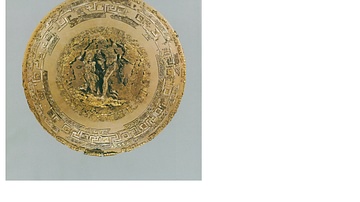
Wreath & Ceremonial Shield from Tomb II, Vergina
The gold wreath and ceremonial shield from the main chamber of Tomb II, in Aigai (Vergina). From Unearthing the Family of Alexander the Great. Grant (2019). Used with permission from Pen & Sword Books.

Image
Iron Peritrachelion (gorget) from Macedonian Tomb II of Vergina
Iron peritrachelion (gorget) with golden-silver decorative plate found in Macedonian Tomb II of Vergina, Imathia, Central Macedonia, Greece. The tomb is dated to between the end of the 4th...
Image
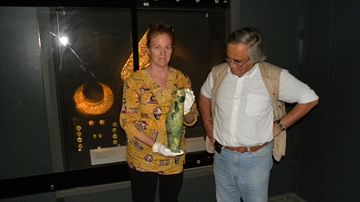
Professor Theodore Antikas with Laura-Wynn Antikas Holding the Shorter Greave from the Royal Tomb of Vergina
Professor Theodore Antikas with Laura-Wynn Antikas holding the shorter greave from the Royal Tomb of Vergina in front of the display cabinet in the Archaeological...
Image
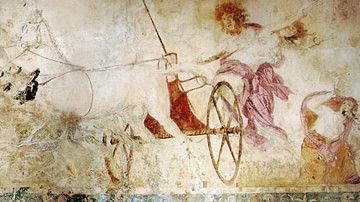
Hades Abducting Persephone, Vergina
A fresco depicting the Abduction of Persephone by Hades, lord of the Underworld, on the wall of Tomb I at Vergina, Macedon, Greece.
Image
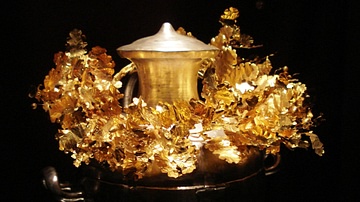
Macedonian Gold Wreath from Vergina
A gold oak wreath and two-handled silver vessel (ampulla) from the main chamber of Tomb II, in the Royal Tombs at Aegae (Vergina).
Image
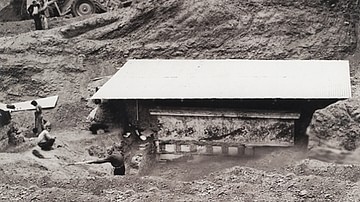
Excavation of the Vaulted Tomb at Aegae, Vergina
The roof and facade of the vaulted tomb in Aegae (Vergina) emerging from the soil in 1977 CE. From Unearthing the Family of Alexander the Great. Grant (2019) p51. Used with permission from Pen & Sword...

Image
Scythian Quiver & Armour of a Woman, Vergina
The gold quiver, shin-guards and neck armour of the female in the unlooted 4th Century BCE tomb at Vergina, Greece, discovered in November 1977 CE.
Image
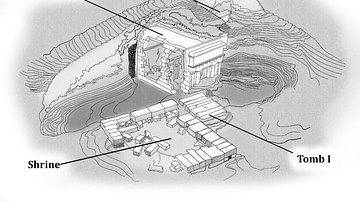
Model of the Shrine & Tombs Under the Great Tumulus, Vergina
A model of the shrine and tombs under the Great Tumulus at Vergina. From Unearthing the Family of Alexander the Great. Grant (2019). p49. Used with permission from Pen & Sword Books.
