
Search
Did you mean: Theseus?
Remove Ads
Advertisement

 This answer was generated by
 Search Results
Image
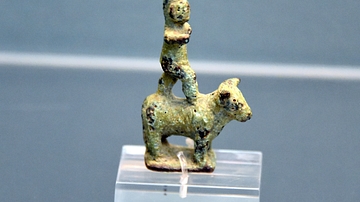
Figure of the Hittite God Teshub
The storm-god Teshub wears a tall headdress and stands on the back of a bull. From modern-day Turkey. Bronze figurine. Hittite period, 1600-1200 BCE. (The British Museum, London).
Definition
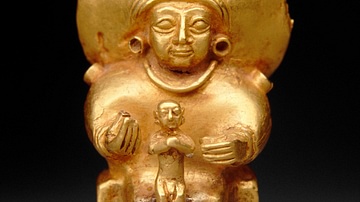
Sauska - The Hurrian's Radiant Goddess of Fertility and War
Sauska (also known as Shaushka, Sausga, and Anzili) was the Hurrian-Hittite goddess of fertility, war, and healing. She was worshipped throughout the region known as Hanigalbat (present day Iraq...
Definition
Adad Nirari I
Adad Nirari I (r. 1307-1275 BCE) was the king of the Assyrian Empire who initiated the first major expansion of the Assyrian kingdom from the city of Ashur throughout the region of Mesopotamia. He also instituted what would become...

Definition
Suppiluliuma I
Suppiluliuma I (1344-1322 BCE) is considered the most powerful and impressive king of the Hittite Empire. He was the son of Tudhaliya II (also known as Tudhaliya III) and is credited with founding the New Kingdom of the Hittites...

Article
Five Key Historical Sites of the Hittites
Although mentioned several times in the Biblical texts, the actual existence of the Hittites was largely forgotten until the late 19th century CE. With the discovery of Hattusa in 1834 CE, the city that was...

Definition
Baal
Baal (also given as Ba'al) is a Canaanite-Phoenician god of fertility and weather, specifically rainstorms. The name was also used as a title, however, meaning "Lord" and was applied to a number of different deities throughout the ancient...

Definition
Ancient Armenia
Ancient Armenia, located in the south Caucasus area of Eurasia, was settled in the Neolithic era but its first recorded state proper was the kingdom of Urartu from the 9th century BCE. Incorporated into the Persian Empire of Cyrus...

Definition
Urartu Civilization
Urartu, also known as the Kingdom of Urartu or the Kingdom of Van, was a civilization which developed in the Bronze and Iron Age of ancient Armenia, eastern Turkey, and northwestern Iran from the 9th century BCE. Controlling...
Definition
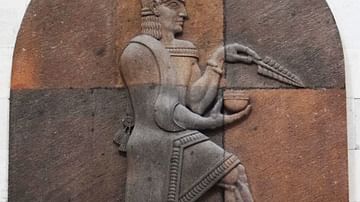
Urartu Religion
The religion of the Urartu civilization, which flourished principally in ancient Armenia from the 9th to 6th century BCE, was a unique mix of indigenous, Hurrian and Mesopotamian gods and symbolism. The pantheon was headed by...
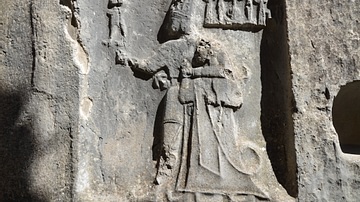
Image
Hittite relief of the God Sharruma and King Tudhaliya
East wall of Chamber B of the Yazilikaya Hittite Rock Sanctuary near Hattusa (13th century BCE) depicting in a niche the God Sharruma (the Hurrian Mountain God and son of the Thunder God Teshub) embracing...
