
Search
Remove Ads
Advertisement

 This answer was generated by
 Search Results

Interview
Interview: When Money Talks by Frank Holt
Join World History Encyclopedia as they talk to Frank Holt about his new book When Money Talks: A History of Coins and Numismatics published by Oxford University Press. Kelly (WHE): Thank you so much for joining me today. Do you want to...
Definition
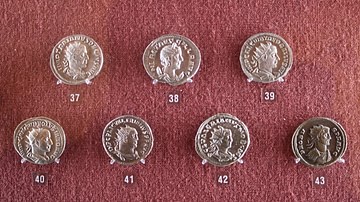
Roman Coinage
Roman coins were first produced in the late 4th century BCE in Italy and continued to be minted for another eight centuries across the empire. Denominations and values more or less constantly changed but certain types such as the sestertii...
Image
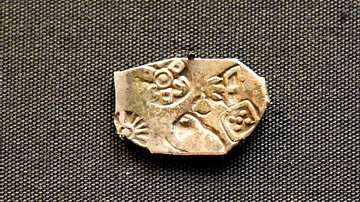
Early Indian Punch-Marked Coin
Early Indian coins were made by cutting sheets of silver into pieces and marking each piece with one or more symbols using small punches. As there are no portraits or inscriptions, the coins are now known by numbers. This coin, for example...
Definition
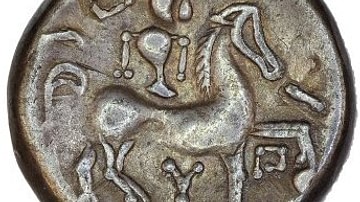
Celtic Coinage
The coinage of the ancient Celts, minted from the early 3rd century BCE to the 1st century CE, at first imitated Greek and then Roman coins. Celtic engravers then soon developed their own unique style, creating distinctive coins with depictions...

Definition
Ancient Greek Coinage
The coinage of ancient Greece has given us some of the most recognisable images from antiquity as they were stamped with designs to proudly declare the identity of the city which minted them and guarantee their value. One of the great archaeological...

Article
Cultural Links between India & the Greco-Roman World
Cyrus the Great (558-530 BCE) built the first universal empire, stretching from Greece to the Indus River. This was the famous Achaemenid Empire of Persia. An inscription at Naqsh-i-Rustam, the tomb of his able successor Darius I (521-486...

Definition
Byzantine Coinage
The coinage of the Byzantine Empire continued that of its more ancient predecessors and functioned as a convenient method of payment for goods and services, especially to soldiers and officials, and as a means for people to pay their taxes...

Image
Justice - Punch Cartoon
A cartoon from Punch magazine parodying the British suppression of the Sepoy Mutiny in India of 1857-8. Cartoon by John Tenniel, 1857.

Image Gallery
A Gallery of 40 Coins Through History
Coins have been in use since their creation in ancient Lydia in the early 6th century BCE. Stamped by the state to guarantee value and be recognisable as genuine, coins allowed goods and services to be bought without the necessity of barter...
Definition
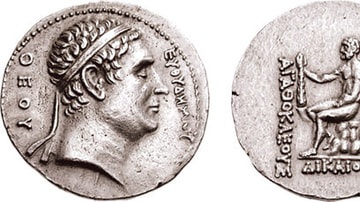
Coinage
Coins were introduced as a method of payment around the 6th or 5th century BCE. The invention of coins is still shrouded in mystery: According to Herodotus (I, 94), coins were first minted by the Lydians, while Aristotle claims that the first...
