
Search
Remove Ads
Advertisement

 This answer was generated by
 Search Results

Article
Marcus Aurelius: Philosopher Emperor or Philosopher-King?
Co-authored by Steven Umbrello and Tina Forsee It is very common to hear in both academic circles, as well as more close-knit Stoic circles, Marcus Aurelius (121 – 180 CE) being referred to as the philosopher king. This is not an idea...

Definition
Stone of Scone
The Stone of Scone (Gaelic: Lia Fail), also known as the Stone of Destiny or Coronation Stone, is a block of sandstone associated with the coronation ceremonies of the medieval monarchs of Scotland. These ceremonies were held at Scone, a...

Definition
Archelaus (Philosopher)
Archelaus of Athens (l. c. 5th century BCE) was a Pre-Socratic philosopher in ancient Greece who claimed the first cause of existence was the opposition of cold and heat which caused the separation of the universal essence to produce a plurality...
![Moabite Stone [Mesha Stele]](https://www.worldhistory.org/img/c/p/360x202/10037.jpg?v=1747932305)
Definition
Moabite Stone [Mesha Stele]
The Moabite Stone, otherwise known as the Mesha Stele, contains an ancient inscription by Mesha, King of Moab during the late 9th century BCE, elements of which match events in the Hebrew Bible. The inscription describes two aspects of how...
Article
Marcus Aurelius: Plato's Philosopher King
Plato's concept of the Philosopher-King (one who governs according to philosophical precepts and higher truths) is thought to be best exemplified through the Roman emperor Marcus Aurelius Antoninus (r. 161-180 CE), the last of the Five Good...

Definition
Stone Age
From the dawn of our species to the present day, stone-made artefacts are the dominant form of material remains that have survived to today concerning human technology. The term “Stone Age” was coined in the late 19th century CE by the Danish...
Article
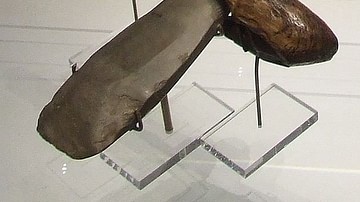
Stone Age Tools
As the Stone Age covers around 99% of our human technological history, it would seem there is a lot to talk about when looking at the development of tools in this period. Despite our reliance on the sometimes scarce archaeological record...

Article
Hipparchia the Cynic: Devoted Wife, Mother, & Outspoken Greek Philosopher
Cynic philosopher, wife of Crates of Thebes (l. c. 360 – 280 BCE), and mother of his children, Hipparchia of Maroneia (l. c. 350 – 280 BCE) defied social norms in order to live her beliefs. She is all the more impressive in that she taught...

Article
Xenophanes the Visionary Poet Philosopher
Xenophanes of Colophon (l.c. 570-c.478 BCE) is known as one of the Pre-Socratic philosophers of ancient Greece, so-called because they pre-date Socrates (l. c. 470/469-399 BCE), recognized as the Father of Western Philosophy. The Pre-Socratics...

Definition
Sun Stone
The Aztec Sun Stone (or Calendar Stone) depicts the five consecutive worlds of the sun from Aztec mythology. The stone is not, therefore, in any sense a functioning calendar, but rather it is an elaborately carved solar disk, which for the...
