
Search
Remove Ads
Advertisement

 This answer was generated by
 Search Results

Definition
Kingdom of Nabatea
The Nabatean Kingdom was a powerful political entity which flourished in the region of modern-day Jordan between the 4th century BCE and c. 106 CE and is best known today for the ruins of its capital city of Petra. Although it is clear that...

Definition
Ancient Jordan
Jordan is a country in the Near East bordered by Israel, Syria, Iraq, and Saudi Arabia. The country's name comes from the Arabic Al Urdun, referencing a fortified site but also meaning "prominence", though various sources also claim the name...
Definition
Kingdom of Saba
Saba (also given as Sheba) was a kingdom in southern Arabia (region of modern-day Yemen) which flourished between the 8th century BCE and 275 CE when it was conquered by the neighboring Himyarites. Although these are the most commonly accepted...

Article
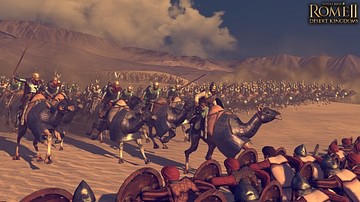
Mavia's Revolt & the Christian Question
In 378 CE the Tanukhid queen Mavia (r. c. 375 - c. 425 CE) of the Saracens led a successful revolt against the Roman Empire, pitting her forces against the armies under the emperor Valens (364-378 CE). Launching her insurrection from the...
Image
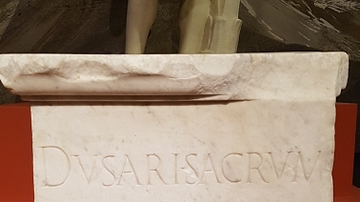
Marble Altar Sacred to Dushares Puteoli
Marble altar sacred to Dushares Puteoli. 1st century CE. Museo dei Campo Flegrei, (National Maritime Museum, Sydney Australia). A beautiful piece of Italian Carrrara marble fashioned into an altar to Dushares, a god of the Nabateans from...

Article
Caesarea Maritima's Role in the Roman Empire
Caesarea Maritima, the city Herod the Great (r. 37-4 BCE) built for Rome on the southeastern coast of the Mediterranean served as the Roman Empire's powerbase of operations both commercially and militarily. With Rome's ultimate goal of adding...

Article
Herod the Great's Building Program
Herod the Great was the king of Judea from 37-4 BCE. As a client king of Rome, Herod's moniker as "Great" was due more to his grand building program throughout the eastern Mediterranean world. Herod's building program generally ran from 35...

Article
Caesarea Maritima's Role in the Mediterranean Trade
Caesarea Maritima was located on the eastern coast of the Mediterranean Sea. Built from the ground up in 22-10 BCE by Rome's client king, Herod the Great (r. 37-4 BCE), its location in relation to ship traffic and proximity to historical...

Article
Hegra and Jabal Ikmah, AlUla, Saudia Arabia - Two different but stunning archaeological sites on the ancient incense trail
Although 30,000 archaeological sites have been identified in the AlUla area of Saudi Arabia, only 8 are currently open to visitors: Jabal Ikmah, which has hundreds of inscriptions; Hegra, a massive site settled during the Nabatean and Roman...
Image
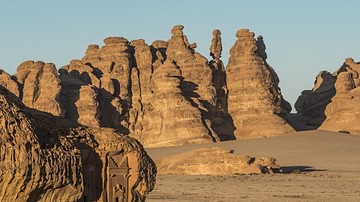
Nabatean Tomb at Hegra
Nabatean tomb at the archaeological site of Hegra, one of many found at AlUla in Saudi Arabia. A UNESCO World Heritage Site, Hegra was a key city of the Kingdom of Nabatea, whose capital was based at Petra in Jordan. The Nabateans were based...
