
Search
Remove Ads
Advertisement

 This answer was generated by
 Search Results

Image
Maitreya Buddha, Three Kingdoms Period
A detail of a gilt bronze statue of the Maitreya (coming) Buddha. Three Kingdoms Period, Korea, c. 600 CE. Height: 80 cm. (National Museum of Korea, Seoul, South Korea)
Image
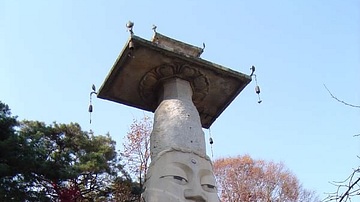
Maitreya Buddha, Gwanchoksa, Korea
A giant granite statue of Maitreya (Miruk) Buddha, Gwanchoksa Temple, Korea. Height: 18.1 m, Goryeo period, 10-11th century CE.
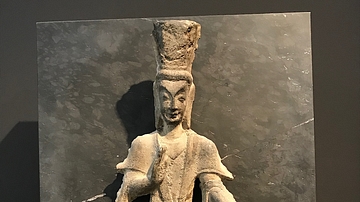
Image
Maitreya Votive from Ancient China
This votive of Maitreya, the Buddha of the future as a bodhisattva, dates from the early 6th century CE during the Northern Wei Dynasty, and it is made of chalkstone. It comes from the Longmen Cave Temples in China's...
Image
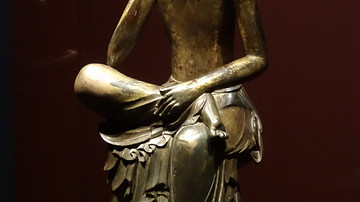
Gilt-bronze Silla Maitreya
A gilt-bronze statue of a seated Maitreya (the future Buddha). Silla, early 7th century CE. (National Museum of Korea, Seoul, South Korea)

Image
Gilt-bronze Maitreya
A gilt-bronze statue of Maitreya (the coming Buddha). Three Kingdoms Period, c. 600 CE, Korea. (National Museum of Korea, Seoul, South Korea)
Image
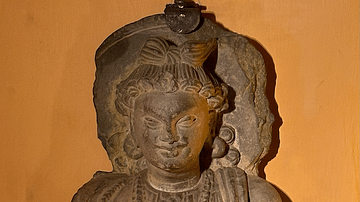
Bejeweled Bodhisattva Maitreya Meditating on a Lotus Seat
Bejeweled Bodhisattva Maitreya meditating on a lotus seat, 2nd-3rd century.
Peshawar Museum, Pakistan.

Definition
Wu Zetian
Empress Wu Zetian (Empress Consort Wu, Wu Hou, Wu Mei Niang, Mei-Niang, and Wu Zhao, l. 624-705 CE, r. 690-704 CE) was the only female emperor of Imperial China. She reigned during the Tang Dynasty (618-907 CE) and was one of the most...
Definition
Ancient Korean Sculpture
The sculpture of ancient Korea was dominated by Buddhist themes such as figurines and monumental statues of the Buddha and his followers, and large bronze bells for temples. Gilded-bronze was the most common material used...

Definition
Emperor Xuanzong of Tang
Xuanzong (birth name, Li Longji, l. 685-762 CE, r. 712-756 CE) was the 7th emperor of the Tang Dynasty of China, whose domestic and foreign policies established the Tang Dynasty as the Golden Age in Chinese history. Many...

Definition
Hwarang
The hwarang was a state-sponsored organisation for the education of elite young males in the ancient kingdom of Silla, Korea. Variously translated as the 'Flower Boys,' 'Flowering Youth,' or 'Elite Youth' (and sometimes, too, the rather...
