
Search
Remove Ads
Advertisement

 This answer was generated by
 Search Results

Image
Lindisfarne
The ruins of Lindisfarne Priory.
Definition
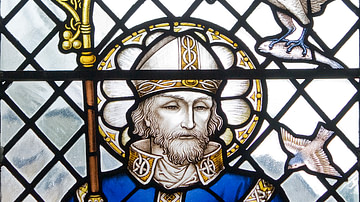
Saint Cuthbert
Saint Cuthbert (c. 634 - 20 March 687) was an Anglo-Saxon monk from the Kingdom of Northumbria, who became the bishop of Lindisfarne and one of the most important saints of the medieval church in England. He first became a monk...

Image
Lindisfarne Gospels Cover
A cover of the Lindisfarne Gospels, produced in the Kingdom of Northumbria 8-10th century CE. (British Library, London)

Image
Lindisfarne Gospels
Initial page of the Gospel of St. Mark from the Lindisfarne Gospels (c. 700-715 CE), created at the Lindisfarne Priory on the “Holy Island” off the coast of Northumbria, Britain.
Image
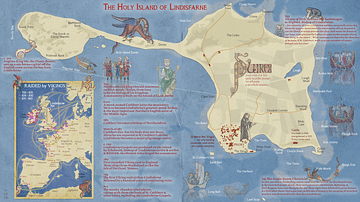
The Holy Island of Lindisfarne
A map illustrating the geography and history of Holy Island, also known as Lindisfarne. A tidal island off the northeast coast of England in Northumberland, it holds significant historical and religious importance...
Image
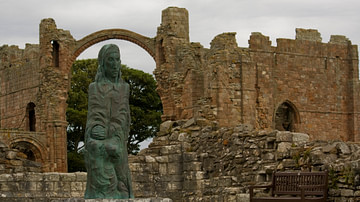
Saint Cuthbert at Lindisfarne
Statue of Saint Cuthbert (c. 634 - 20 March 687) at Lindisfarne Priory.

Article
Viking Raids in Britain
The Viking raids and subsequent settlements define the period known as the Viking Age in Britain which had profound consequences on the development of the culture and language. The raids started in June of 793 CE when three...

Definition
Hilda of Whitby
Hilda of Whitby (also known as Saint Hilda of Whitby, l. 614-680 CE) was the founder and abbess of the monastery at Whitby, Kingdom of Northumbria, Britain. She was a Northumbrian princess who converted to Christianity with the...

Definition
Illuminated Manuscripts
Illuminated manuscripts were hand-made books, usually on Christian scripture or practice, produced in Western Europe between c. 500-c. 1600. They are so called because of the use of gold and silver which illuminates the...

Definition
Synod of Whitby
The Synod of Whitby was an assembly held in 664 by King Oswiu of Northumbria, with the aim of deciding whether Oswiu's kingdom should follow Roman Christian customs or those of the Irish Christians at Iona, particularly regarding...
