
Search
Remove Ads
Advertisement

 This answer was generated by
 Search Results
Image
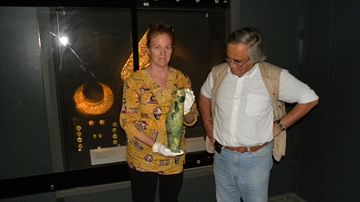
Professor Theodore Antikas with Laura-Wynn Antikas Holding the Shorter Greave from the Royal Tomb of Vergina
Professor Theodore Antikas with Laura-Wynn Antikas holding the shorter greave from the Royal Tomb of Vergina in front of the display cabinet in the Archaeological Museum of Vergina. Courtesy of the Antikas team archive.

Video
The myth of Medusa - Laura Aitken-Burt
TED-Ed has launched its first ever physical game: Pandora's Legacy! Learn more and get your copy here: https://ed.ted.com/pandora – Medusa, transformed into a monstrous Gorgon by a wrathful Athena, sought refuge in a hidden cave. Time...

Definition
Stonewall Jackson - General Lee's Lieutenant
Thomas J. Jackson (1824-1863), better known as Stonewall Jackson, was one of the most famous Confederate generals of the American Civil War (1861-1865). A veteran of the Mexican-American War and a former VMI instructor, he joined the Confederate...

Definition
Petrarch
Petrarch (1304-1374 CE), full name Francesco Petrarca, was an Italian scholar and poet who is credited as one of the founders of the Renaissance movement in art, thought, and literature. Petrarch actively searched for 'lost' ancient manuscripts...

Definition
Galileo Galilei
Galileo Galilei (1564-1642) was an Italian mathematician, physicist, astronomer, and natural philosopher. He created a superior telescope with which he made new observations of the night sky, notably that the surface of the Moon has mountains...

Definition
Johannes Kepler
Johannes Kepler (1571-1630) was a German astronomer and mathematician most famous for creating what was up to that point the most accurate model of planetary astronomy with his three laws of planetary motion. Kepler was the first to present...

Article
The Telescope & the Scientific Revolution
The invention of the telescope in 1608 is usually credited to the Dutchman Hans Lippershey. The astronomical telescope became one of the most important of all instruments during the Scientific Revolution when figures like Galileo (1564-1642...

Article
The Thermometer & the Scientific Revolution
The thermometer was invented in the mid-17th century during the Scientific Revolution when scientists began to search for an accurate instrument to measure a wide range of temperatures using a scale that could be compared with other readings...

Article
Roman Education
Roman education had its first 'primary schools' in the 3rd century BCE, but they were not compulsory and depended entirely on tuition fees. There were no official schools in Rome, nor were there buildings used specifically for the purpose...

Article
Roman Girls and Marriage in Ancient Rome
In ancient Rome, the legally acceptable age for marriage for girls was twelve. Although in middle-class Roman society, the most common age of first marriage for a girl was mid-to-late teens, evidence also shows that in a section of elite...
