
Search

 This answer was generated by
 Search Results
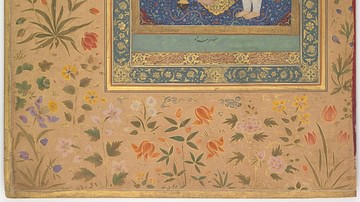
Image
Jahangir and His Vizier, I'timad al-Daula
Jahangir and His Vizier, I'timad al-Daula, folio from the Shah Jahan Album, ink, opaque watercolor, and gold on paper by Manohar, India, c. 1615. Mughal emperor Jahangir (r. 1605-27) bestowed the title of l'timad al-Daula (meaning "reliance...

Image
Sir Thomas Roe at the Court of Jahangir
The court of the Mughal emperor Jahangir (r. 1605-1627). Here in attendance at the court in Agra is Sir Thomas Roe (1581-1644) who secured permission for the East India Company the right to set up its first trading post at Surat on the west...

Video
Gardens in Indian Art - Jahangir and Prince Khurram with Nur Jahan
Tour this famous Indian Royal Garden as depicted in a 17th C. painting.

Article
Royal Women in the Mughal Empire
It was not only the Mughal emperors that left an indelible mark in the history of the Indian subcontinent but also the queens and princesses. The latter's contributions to art, architecture, literature, cuisine, refinement, and administrative...

Article
The English and Dutch East India Companies' Invasions of India
In the early 17th century, the Dutch and English East India Companies turned their eyes towards India, as part of their grand schemes to develop extensive trade networks across the Indian and China Seas. They were faced with two significant...
Image
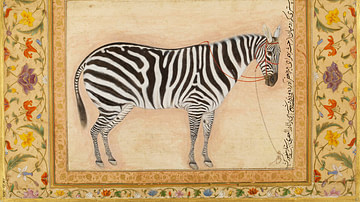
Mughal Zebra Painting
A zebra presented to the fourth Mughal Emperor Jahangir (1569-1627). Opaque watercolour and gold on paper, by Mansur, 1621, Mughal. Museum no. IM.23-1925. © Victoria and Albert Museum, London

Definition
East India Company
The English East India Company (EIC or EEIC), later to become the British East India Company, was founded in 1600 as a trading company. With a massive private army and the backing of the British government, the EIC looted the Indian subcontinent...
Image
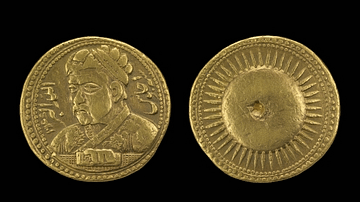
Mughal Gold Coin of Emperor Akbar
A gold mohur coin issued by Mughal Emperor Jahangir (r. 1605-28) bearing a portrait of his Father, Akbar. The coin was issued in 1605, the first year of Jahangir's reign. The inscription in Arabic next to the portrait translates as 'Allahu...
Article
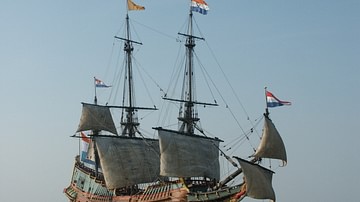
Wreck of the Batavia
The Batavia was a Dutch East India Company ship that foundered on the coral reefs of the Houtman Albrolhos Islands, 60 kilometres (37 mi) off the coast of Western Australia, just before dawn on 4 June 1629. It was the flagship of a fleet...

Article
Mandu - City of Joy
The city of Mandu is situated about 35 km from Dhar in the Madhya Pradesh region of northern-central India. Most of the city's monuments date to the 15th and 16th century CE. The city is located on a hill which rises 633 m above the sea level...
