
Search
Remove Ads
Advertisement

 This answer was generated by
 Search Results

Image
Recreation of the Etemenanki in Babylon
The Etemenanki (Sumerian for: "temple of the foundation of heaven and earth") was a massive ziggurat dedicated to Marduk in ancient Babylon. It is unclear when the Etemenanki was originally constructed, and it is sometimes associated with...

Definition
Babylon - The Gate of the Gods
Babylon is the most famous city from ancient Mesopotamia, whose ruins lie in modern-day Hillah, Iraq, 59 miles (94 km) southwest of Baghdad. The name is derived from bav-il or bav-ilim, which in Akkadian meant "Gate of God" (or "Gate of the...

Definition
Ziggurat - Mountains of the Gods
A ziggurat is a form of monumental architecture originating in ancient Mesopotamia, which usually had a rectangular base and was built in a series of steps up to a flat platform upon which a temple was raised. The ziggurat was an artificial...

Definition
Nebuchadnezzar II
Nebuchadnezzar II (r. 605/604-562 BCE) was the greatest King of ancient Babylon during the period of the Neo-Babylonian Empire (626-539 BCE), succeeding its founder, his father, Nabopolassar (r. 626-605 BCE). He is best known from the biblical...

Article
12 Great Cities of Ancient Mesopotamia - The Rise and Fall of the Earliest Cities in the World
The great cities of Mesopotamia ("the land between two rivers") developed prior to the late 4th millennium BCE along two rivers – the Tigris and Euphrates – and were fully established by the Early Dynastic period (circa 2900 to circa 2350/2334...
Image
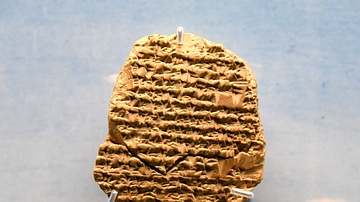
E-sagil Tablet & Building the Tower of Babel
This tablet states the dimensions of each of the seven levels of Etemenanki, the ziggurat of Marduk at Babylon. This building is the Tower of Babel in the Book of Genesis. From Babylon, Southern Mesopotamia, Iraq. Circa 600-400 BCE. (The...
