
Search
Did you mean: Dionysos?

 This answer was generated by
 Search Results
Definition
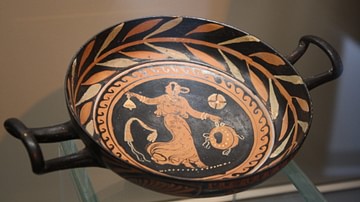
Bacchae
The Bacchae is a Greek tragedy written by the playwright Euripides (c. 484-406 BCE) in 407 BCE, which portrays Pentheus as an impious king, for the ruler of Thebes has denied the worship of Dionysus within his city walls. For Pentheus, the...

Definition
Iphigenia in Aulis
Iphigenia in Aulis (or at Aulis) was written by Euripides, the youngest and most popular of the trilogy of great Greek tragedians. The play was based on the well-known myth surrounding the sacrifice of Agamemnon and Clytemnestra's daughter...

Definition
Libation Bearers
The play Libation Bearers was written by one of the greatest of all Greek tragedians Aeschylus (c. 525-455 BCE). Winning first prize at the Dionysia competition in 458 BCE, Libation Bearers was the second play in the trilogy The Oresteia...
Definition
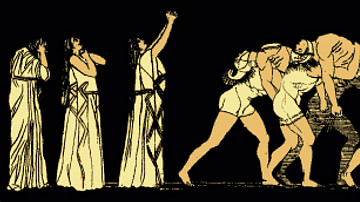
Suppliants by Euripides
The Suppliants (also given as Suppliant Women) is a Greek tragedy written by Euripides, not to be confused with Aeschylus' tragedy of the same title. Its exact date of production is not known, possibly around 424 to 420 BCE, and may have...

Definition
Sophocles
Sophocles of Kolōnos (c. 496 - c. 406 BCE) was one of the most famous and celebrated writers of tragedy plays in ancient Greece and his surviving works, written throughout the 5th century BCE, include such classics as Oedipus Rex, Antigone...

Definition
Antigone
Antigone was the third play in the Oedipus trilogy written by the great Greek playwright Sophocles (c. 496 - c. 406 BCE). Produced around 441 BCE and receiving first prize at the Dionysia festival, the tragedy was actually written long before...

Definition
Cynisca of Sparta
Cynisca of Sparta (b. c. 440 BCE) was a Spartan royal princess who became the first female Olympic champion. Defying the traditional role of women in ancient Greece, she competed in the Olympic Games alongside the men and won. Her triumph...
Definition
The Eumenides
The Eumenides is a play written by Aeschylus (c 525 – 455 BCE), the “Father of Greek Tragedy,” the most popular and influential of all tragedians of his era. The Eumenides was the third play of a trilogy, The Oresteia, with the remaining...

Definition
Agamemnon (Play)
The play Agamemnon was written by one of the greatest Greek tragedians Aeschylus (c. 525 – 455 BCE), “Father of Greek Tragedy.” Older than both Sophocles and Euripides, he was the most popular and influential of all tragedians of his era...

Definition
Electra by Euripides
Electra is a Greek tragedy written by the playwright Euripides, c. 420 BCE. It retells the classic myth concerning the plotting of Electra and her brother Orestes to kill their mother and her lover. This version of the story should not be...
