
Search
Remove Ads
Advertisement

 This answer was generated by
 Search Results

Definition
Crusader States
The Crusader States (aka the Latin East or Outremer) were created after the First Crusade (1095-1102) in order to keep hold of the territorial gains made by Christian armies in the Middle East. The four small states were the Kingdom of Jerusalem...

Article
The Armour of an English Medieval Knight
English medieval knights wore metal armour of iron or steel to protect themselves from archers and the long swords of opponents. From the 9th century CE, chain mail suits gave protection and freedom of movement until solid plate armour became...

Article
Armour in Ancient Chinese Warfare
With zinging arrows, powerful crossbow bolts, stabbing swords, and swinging axes all a staple feature of the Chinese battlefield, it is not surprising that soldiers sought to protect themselves as best they could with armour and shields...

Definition
Fifth Crusade
The Fifth Crusade (1217-1221 CE) was called by Pope Innocent III (r. 1198-1216 CE) with the objective, like previous crusades, of recapturing Jerusalem from Muslim control; only this time the strategy was to weaken the enemy by first attacking...
Article
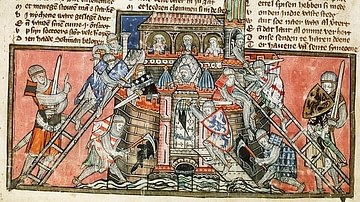
The Siege of Antioch, 1097-98 CE
The siege of Antioch in 1097-1098 CE occurred during the First Crusade (1095-1102 CE) when the western Crusader knights were on their way to retake Jerusalem. The great metropolis of Antioch in northern Syria was heavily fortified, and it...

Article
Zengids & the Crusaders: Race for Egypt (1163-1169 CE)
In the aftermath of the failure of the Second Crusade (1147-1149 CE), which only managed to bring Damascus under Nur ad-Din's (sometimes also given as Nur al-Din, l. 1118-1174 CE) dominion, Egypt acquired top priority – both from a strategic...
Article
The Armies of the Crusades
The armies of the Crusades (11th-15th centuries CE), which saw Christians and Muslims struggle for control of territories in the Middle East and elsewhere, could involve over 100,000 men on either side who came from all over Europe to form...

Definition
Kingdom of Jerusalem
The Kingdom of Jerusalem was a state created in 1099 CE by Crusaders and western settlers after the First Crusade (1095-1102 CE). With Jerusalem as its capital, the kingdom was the most important of the four Crusader States in the Middle...

Article
The Siege of Damascus, 1148 CE
The siege of Damascus in 1148 CE was the final act of the Second Crusade (1147-1149 CE). Lasting a mere four days from 24 to 28 July, the siege by a combined western European army was not successful, and the Crusade petered out with its leaders...

Article
Saladin's Conquest of Jerusalem (1187 CE)
Jerusalem, a holy city for the adherents of all three great monotheistic religions (Judaism, Christianity, and Islam) was conquered by the armies of the First Crusade in 1099 CE. The Muslims failed to halt their advance, as they were themselves...
