

The word "plastic" comes from the Greek verb plasso, meaning, "I model," and describes vases made via molding, which allowed artisans to reproduce complex human, animal, or plant shapes. Potters added handles and mouths to molded clay parts, creating small numbers of nearly identical mass-produced vessels. This video focuses on an ancient Athenian drinking cup from about 470 B.C., made, in part, by molding. It was designed in the shape of two joined heads: the hero Herakles, and a woman. This presentation explains the cup's construction, painting, and firing. Love art? Follow us on Google+ to stay in touch: http://bit.ly/gettygoogleplus Double-Headed Wine Cup with Herakles, Class M: Vatican Class, about 470 B.C., Republic of Italy
Related Content

Ancient Greek Pottery

Making and decorating Athenian black- and red-figure vases

The Athenian Calendar
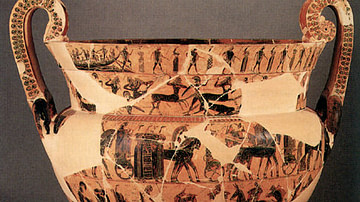
François Vase

The Delian League, Part 6: The Decelean War and the Fall of Athens (413/2-404/3 BCE)

A Visual Glossary of Greek Pottery
Cite This Work
APA Style
Museum, G. (2016, February 19). Making a Molded Athenian Vase. World History Encyclopedia. https://www.worldhistory.org/video/754/making-a-molded-athenian-vase/
Chicago Style
Museum, Getty. "Making a Molded Athenian Vase." World History Encyclopedia, February 19, 2016. https://www.worldhistory.org/video/754/making-a-molded-athenian-vase/.
MLA Style
Museum, Getty. "Making a Molded Athenian Vase." World History Encyclopedia, 19 Feb 2016, https://www.worldhistory.org/video/754/making-a-molded-athenian-vase/.
