

The colony of Augusta Emerita, which became present-day Mérida in Estremadura, was founded in 25 B.C. at the end of the Spanish Campaign and was the capital of Lusitania. The well-preserved remains of the old city include, in particular, a large bridge over the Guadiana, an amphitheatre, a theatre, a vast circus and an exceptional water-supply system. It is an excellent example of a provincial Roman capital during the empire and in ... Source: UNESCO TV / © NHK Nippon Hoso Kyokai URL: http://whc.unesco.org/en/list/664/
Related Content

RMS Lusitania - Tragic Victim of WWI
Colchis & Iberia in Antiquity

Roman Architecture

Renaissance Architecture
Interview: Numantia - Recreating the Ancient Iberian World
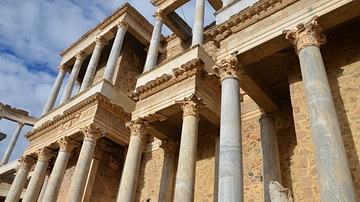
Top 5 Roman Sites in Southern Spain
Cite This Work
APA Style
Kyokai, U. T. N. N. H. (2018, September 04). Archaeological Ensemble of Mérida (UNESCO/NHK). World History Encyclopedia. https://www.worldhistory.org/video/1452/archaeological-ensemble-of-merida-unesconhk/
Chicago Style
Kyokai, UNESCO TV NHK Nippon Hoso. "Archaeological Ensemble of Mérida (UNESCO/NHK)." World History Encyclopedia, September 04, 2018. https://www.worldhistory.org/video/1452/archaeological-ensemble-of-merida-unesconhk/.
MLA Style
Kyokai, UNESCO TV NHK Nippon Hoso. "Archaeological Ensemble of Mérida (UNESCO/NHK)." World History Encyclopedia, 04 Sep 2018, https://www.worldhistory.org/video/1452/archaeological-ensemble-of-merida-unesconhk/.
