
Search Images
Browse Content (p. 352)
Image
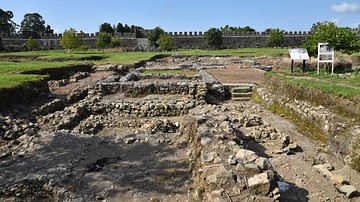
Remains of the Apsarus Roman Fort
Remains of the commanding officer's residence at the Roman fort of Apsarus in modern-day Georgia. The fort (known today as the Gonio Fortress) is located 15 kilometres (9.3 mi) south of Batumi near the Turkish border. It was the largest...
Image
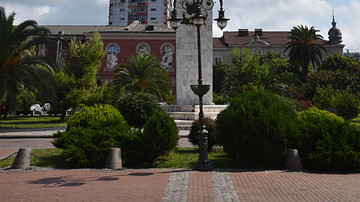
Modern Statue of Medea
Statue of Medea, a Colchian princess best known in Greek mythology for her relationship with the Greek hero Jason, created by the famous Georgian sculptor Davit Khmalazde, erected in 2007 in Batumi, Georgia. The sculpture symbolizes the...
Image
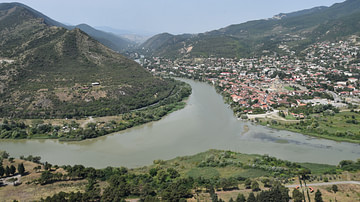
View of Armaziskhevi
View of the Armaziskhevi Archaeological Site (left hill) and the confluence of the Aragvi and Mtkvari rivers from the Jvari Monastery, which overlooked Mtskheta, the capital of the early Georgian Kingdom of Iberia from the 3rd century BCE...
Image
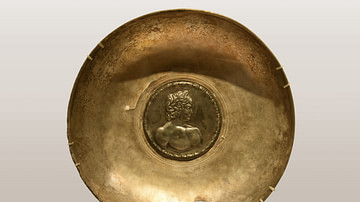
Antinous on a Silver Dish
A silver dish (patera) bearing the bust of Antinous in its central medallion, from a 2nd-century CE burial (a tomb supposed to have belonged to the high Iberian dignitary Aspaurukis) at the Armaziskhevi archaeological site in Georgia. It...
Image
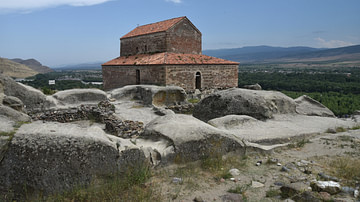
Uplistsulis Eklesia in Uplistsikhe Cave Town
Uplistsulis Eklesia (Prince's Church) is a three-nave basilica built in the 10th century CE near the top of the hill of Uplistsikhe Cave Town (Eastern Georgia) over what was probably the city's most important pagan temple. Uplistsikhe is...
Image
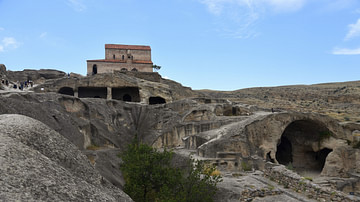
Uplistsikhe Cave Town, Georgia
Uplistsikhe is an ancient rock-hewn town in Georgia, featuring a complex of caves and tunnels carved into the rock. Dating back to the early Iron Age (c. 1000 BCE), it served as a significant political, religious, and cultural centre. The...
Image
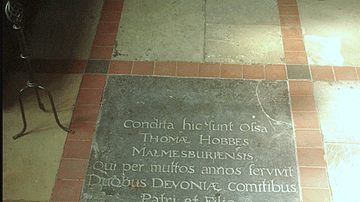
Tomb of Thomas Hobbes
The tomb of the English philosopher Thomas Hobbes (1588-1679). St John the Baptist Church, Ault Hucknall, Derbyshire, England.

Image
Thomas Hobbes by Faithone
A 1668 engraving of the English philosopher Thomas Hobbes (1588-1679). Engraving by William Faithorne.

Image
Leviathan Frontispiece
The frontispiece to Leviathan by the English philosopher Thomas Hobbes (1588-1679) which was published in 1651. Engraving by Abraham Bosse.
Image
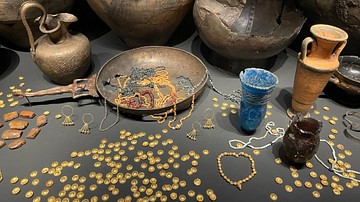
Treasures from a Woman's Burial in Vani
Grave goods from the richest burial at Vani (located in the Imereti region of Georgia), dated to about 450 BCE. Grave 11, contained four bodies inside a wooden structure: a woman, distinguished by the richness of her personal ornaments...
