
Search Images
Browse Content (p. 307)
Image
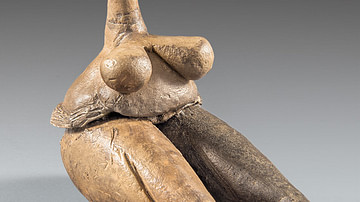
Neolithic Clay Figurine from West Iran
Neolithic clay goddess from Tappah Sarab, Kermanshah, 7000-6100 BCE. Clay figurines of female bodies with exaggerated reproductive organs are among the most common features of prehistoric sculpted art. With famous examples from Venus of...
Image
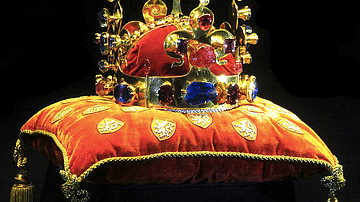
Crown of Saint Wenceslaus
A replica of the Crown of Saint Wenceslaus. The Bohemian Duke Wenceslaus I (r. 921-935) was given the honorary title of king by Otto I, Holy Roman Emperor (r. 962-973) and made a saint. This crown was made in his honour in the mid-14th century...
Image
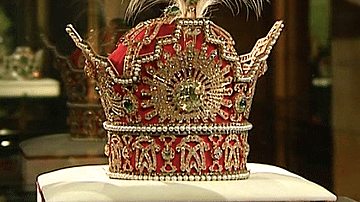
The Pahlavi Crown
The Pahlavi Crown, first worn by Reza Shah Pahlavi, Shah of Iran, at his coronation in April 1926. The design reminds of the rulers of the Sassanid dynasty (3rd-7th centuries CE). Made of gold and silver on a red velvet backing. Weighing...
Image
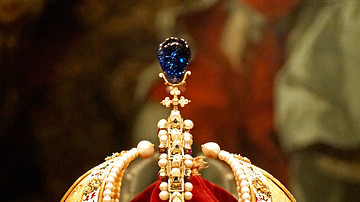
Imperial Crown of Austria
The Imperial Crown of Austria. Made in 1602, this crown has been used by the Habsburg monarchs of Austria, the Holy Roman Empire, and the Austro-Hungarian Empire, and the kings of Hungary and Bohemia. The crown combines the traditional crown...

Image
Tiara of Pope Pius IX
The tiara of Pope Pius IX (in office 1846-1878). Made in 1854. Made of a trio of gold crowns set with diamonds, emeralds, sapphires, pearls, and other jewels around a silver-thread fabric. It measures 35 cm (13.7 in) in height and diameter...
Image
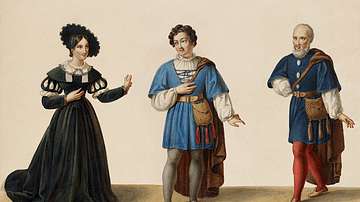
Costumes for William Tell
An illustration of the costumes used in the first production of the opera William Tell. The serious opera, composed by Gioachino Rossini (1792-1868), premiered at the Opéra in Paris on 3 August 1829. Drawn by Eugène Du Faget.
Image
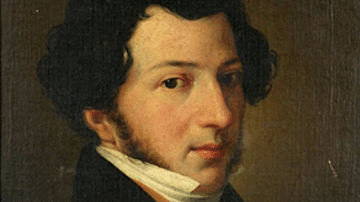
Gioachino Rossini c. 1815
A c. 1815 portrait of the composer Gioachino Rossini (1792-1868). (Accademia nazionale di Santa Cecila, Rome)
Image
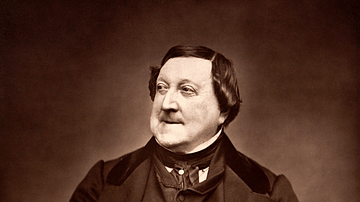
Gioachino Rossini in 1865
A photograph of the composer Gioachino Rossini (1792-1868). Taken in 1865 by Étienne Carjat. (Harvard Art Museum)

Image
Map of the Caucasus after the Peace of Nisibis, c. 300 CE
The First Peace of Nisibis (299 CE) established a rare moment of stability in the long rivalry between the Roman and Sasanian Empires, fixing their borders in the Caucasus after Emperor Diocletian (reign 284–305 CE) and his co-emperor Galerius...
Image
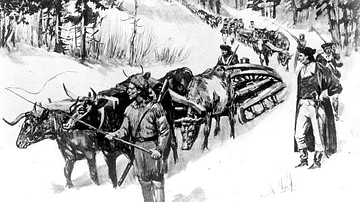
Henry Knox Hauling Artillery to Boston
Colonel Henry Knox bringing the artillery from Fort Ticonderoga to Cambridge, Massachusetts, to help bring an end to the Siege of Boston, by an unknown artist, 1775.
National Archive, collection number: 111-SC-100815.
