
Search Images
Browse Content (p. 1814)
Image
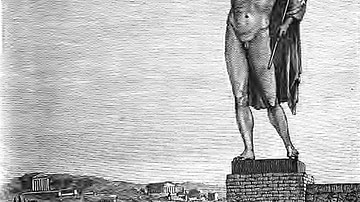
Colossus of Rhodes
An artist's impression of what the Colossus of Rhodes statue, one of the Seven Wonders of the ancient world, may have looked like. (19th century engraving by Sidney Barclay)

Image
Lion from the Mausoleum at Halicarnassus
One of the few free-standing sculptures from the Mausoleum at Halicarnassus, 4th century BCE. (British Museum, London)

Image
Marcus Licinius Crassus Bust
A bust of Roman statesman and general Marcus Licinius Crassus (c. 115-53 BCE). Glyptothek, Copenhagen.
Image
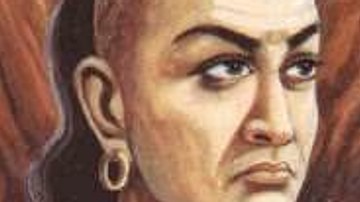
Kautilya
An artist's impression of Kautilya, the 4th to 3rd century BCE Indian statesman and philosopher. From a cover of a 1915 CE edition of the 'Arthashastra' translated by Rudrapatnam Shamasastry.

Image
Archimedes by Fetti
Archimedes Thoughtful, painted 1620 CE in Mantua by Domenico Fetti (1588–1623).
Gemäldegalerie Alte Meister, Dresden, Germany.

Image
Nymph with Scorpion
Nymph with scorpion. Marble statue by Lorenzo Bartolini (1777-1850), commissioned by Prince Charles de Beauvau, exhibited at the 1845 Salon.
Louvre Museum, Department of Sculptures, ground floor, room 4.
Image
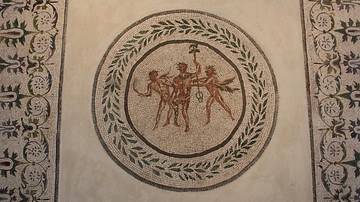
Roman Satyrs Floor Mosaic
A 2nd century CE floor mosaic depicting Dionysos and satyrs with laurel crowns. From the area of the Villa della Farnesina, Rome. (Palazzo Massimo, Rome)

Image
Dying Niobid
A 5th century BCE marble sculpture of one of the daughters of Niobe, dying from an arrow wound in her back. According to the story from Greek mythology Niobe insulted the goddess Lato by thinking herself more worthy. Lato then had her children...

Image
Julio-Claudian Family Tree
Family tree of Julio-Claudian Dynasty, which produced five emperors at the start of the Roman Empire (27 BCE - 68 CE).

Image
Cocijo
An urn representing the Zapotec deity Cocijo who had a human body with jaguar and serpent features with a forked tongue and was considered the god of rain and lightning. (200 BCE - 700 CE, Stanford Cantor Museum)
