
Search Images
Browse Content (p. 1740)
Image
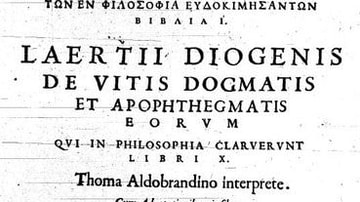
Diogenes Laërtius: Lives and Opinions of Eminent Philosophers
Title page from 1594 edition of Diogenes Laërtius' "Lives and Opinions of Eminent Philosophers."
Image
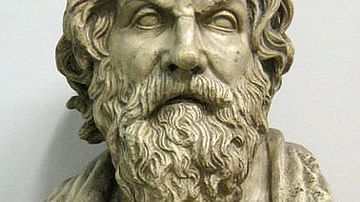
Antisthenes Bust
Bust of Antisthenes from the Pushkin Museum, Moscow
Image
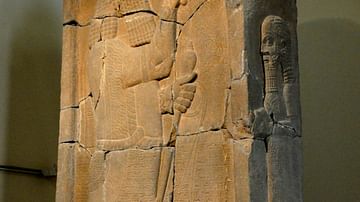
Sam'al Stele of King Esarhaddon
This commemorative basalt stele depicts the Assyrian king Esarhaddon worshiping gods and symbols of gods. The king's left hand holds a royal mace and two ropes. These ropes pass through the lips of two captives. The kneeling smaller figure...

Image
Boudhanath Stupa
A major Buddhist stupa located in Boudhanath, roughly 11 km from Kathmandu, Nepal. This stupa is one of the largest Stupas in the world, built on an ancient trade route linking Tibet with the Kathmandu Valley.
Image
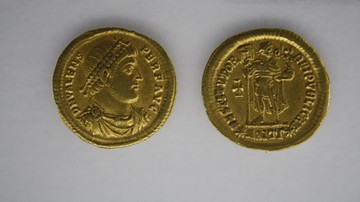
Valens Gold Solidus
Two gold solidus coins depicting Roman emperor Valens, r. 364-378 BCE. Provenance: north-west France. (Vannes Archaeological Museum, France)

Image
Neolithic Gold Bead
A gold bead from the dolmen d'Er Roh, La Trinite Sur Mer, France, 2200-2000 BCE.
Vannes Archaeological Museum, France.
Image
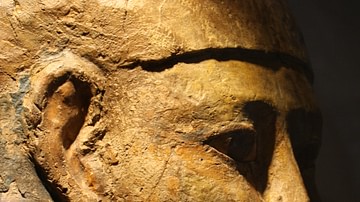
Egyptian Priest Sarcophagus
Egyptian sarcophagus of Ankh-ef-Khons, a priest of Thebes. Wood, 945-712 BCE. (Vannes Archaeological Museum, France)

Image
Bishop Absalon topples the god Svantevit at Arkona
Painting by Laurits Tuxen showing a Christian Bishop displacing an image of the pagan Slavic deities during the Christianisation process of the Slavic culture. Most the Slavic mythology and lore was lost during this time.

Image
The Defeat of Sennacherib
The Defeat of Sennacherib, Peter Paul Rubens, 1612 CE, Alte Pinakothek, Munich.
Image
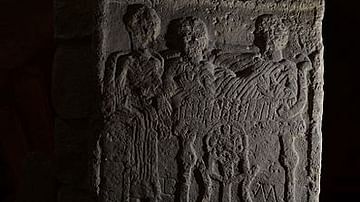
Stele with Epitaph from Roman Dacia (Romania)
A Roman stele with an epitaph from the ancient town of Potaissa in Dacia (present-day Turda, Romania). It was made between c.151-270 CE. Height: 205 cm (80.7 in) Width: 77 cm (30.3 in) Depth: 17 cm (6.7 in) Transcription: Valeria...
