
Search Images
Browse Content (p. 1288)
Image
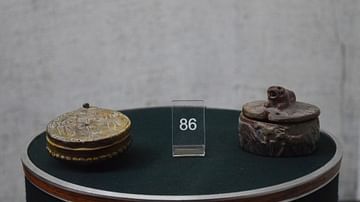
Urartian Jewelry Boxes
These Urartian jewelry boxes are made of stone and were found at Karmir Blur (the Teishebaini Fortress), which is located in present-day Yerevan, Armenia. (Erebuni Historical and Archaeological Preserve, Yerevan, Armenia.)
Image
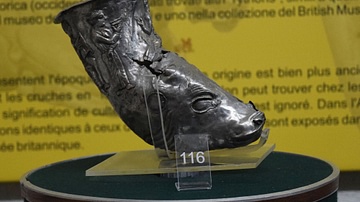
Persian Ox Head Rhyton with Feast Scene
This ox head rhyton with a feast scene is from the Erebuni Fortress, which is located in what is present-day Yerevan, Armenia. It is made of silver and dates from the 4th century BCE when the Erebuni Fortress was under the control of the...
Image
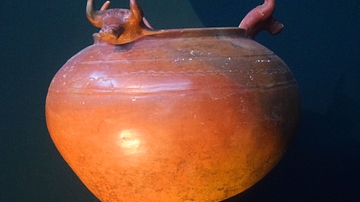
Urartian Ritual Vessel with Bull Heads
This Urartian ritual vessel made from baked clay is decorated with the heads of three bulls. It was found in the Biani tomb in what's present-day Yerevan, Armenia, and it dates from the 8th century BCE. (Erebuni Historical and Archaeological...
Image
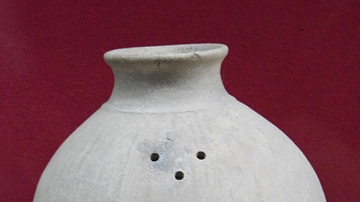
Urartian Burial Urn
This burial urn was discovered near the ancient Erebuni Fortress. It dates from the 8th century BCE and is made from baked clay. (Erebuni Historical and Archaeological Preserve, Yerevan, Armenia.)

Image
Fragments of a Helmet from Erebuni Fortress
These are fragments of a helmet that presumably belonged to an ancient Urartian soldier. It was made aroun the 7th century BCE. (Erebuni Historical and Archaeological Preserve, Yerevan, Armenia.)
Image
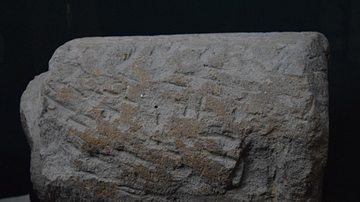
Water Pipe from Ancient Yerevan
This immense water pipe made of stone once supplied water to Erebuni Fortress in what's present-day Yerevan, Armenia. This pipe dates from the 11th century BCE. (Erebuni Historical and Archaeological Preserve, Yerevan, Armenia.)
Image
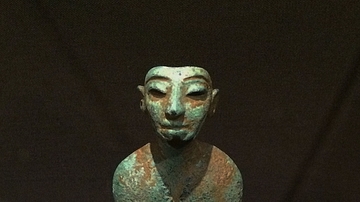
Syrian Seated God Statuette
This small bronze of an enthroned god, wearing sandals and a long wrapped cloak with ribbed ornamentation near the ankles, reflects the balance between stylization and specific adornment that many modern artists like Modigliani, Picasso...
Image
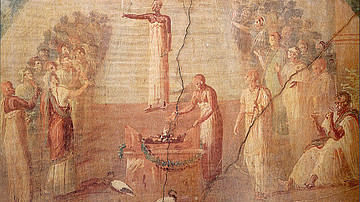
Roman Mural of Isiac Cult
The cult of the Egyptian goddess Isis first spread to Rome during the Hellenistic period and it enjoyed popularity until the adoption of Christianity throughout the Roman Empire in the 4th century CE. This mural from a temple to Isis in Herculaneum...
Image
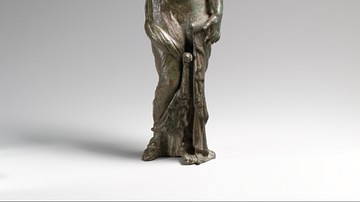
Statuette of Isis-Venus
This bronze statuette from the late 2nd Century CE depicts the Egyptian goddess Isis in Hellenized form as Aphrodite but wearing the traditional vulture cap and knotted robe of Isis. Isis was a popular deity in the Roman world from the Hellenistic...
Image
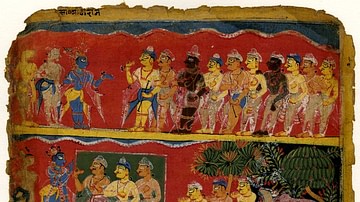
Bhagavata Purana
Page from a manuscript of the Bhagavata Purana. Three cowherds bring their cows to the river Yamuna to drink, then they ask Kṛṣṇa how to find food. Above, Kṛṣṇa tells a group of cowherds, all standing in a line to go and ask the brahmin ladies...
