
Search Images
Browse Content (p. 1113)
Image
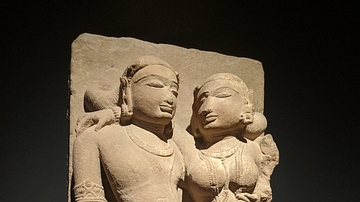
Amorous Indian Couple Relief
Amorous couple from central India, Chandella Dynasty, 11th century CE.
Exhibited at Museum Rietberg, Zurich, Switzerland.

Image
Siddhartha's Secret Escape, Gandhara Relief
The prince Siddhartha secretly leaves the palace of his father. Not to wake the sleeping inhabitants of the palace, yakshas lift his horse on its hooves and carry it above the ground. Gandhara region, Pakistan, 3rd / 4th century CE...
Image
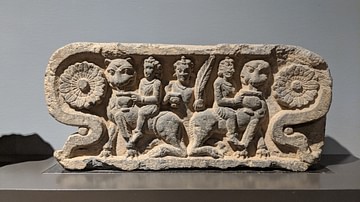
Gandhara Lions & Genii Relief
Lions and Genii (Djinns), Gandhara region, India, 5th century CE. Exhibited at Museum Rietberg, Zurich, Switzerland.
Image
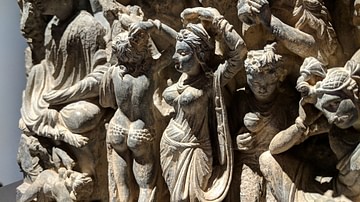
Mara's Daughters Tempt the Buddha
The temptation of the Buddha by Mara's daughters. Slate, Gandhara region, Pakistan, 2nd to 4th century CE. Exhibited at Museum Rietberg, Zurich, Switzerland.
Image
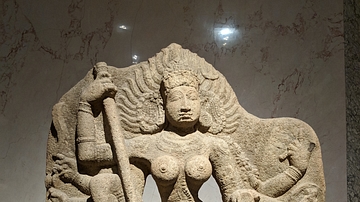
Durga Slays Mahisha
The goddess Durga slaying the buffalo demon Mahisha. This sculpture shows the terrifying goddess while killing a demon. In her hands she holds her typical attributes of a trident, skull drum, sacrificial knife, sling, shield, bell, and a...
Image
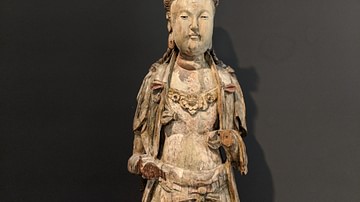
Guanyin, Song Dynasty
Guanyin, the Bodhisattva of Compassion. Song Dynasty (960-1279 CE), China. Wooden, painted and gilded. Exhibited at Museum Rietberg, Zurich, Switzerland.
Image
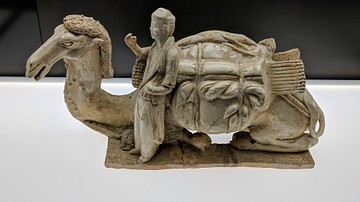
Camel with Guide, Tang Dynasty
Lying camel with guide, China, Tang Dynasty, early 7th century CE. Made from stone with a white glaze. Exhibited at Museum Rietberg, Zurich, Switzerland.
Image
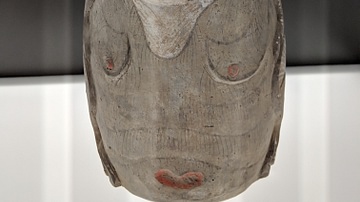
Bear-Shaped Jar from the Han Dynasty
A jar in the shape of a bear, Shaanxi / Henan Region, China. Western Han Dynasty, 2nd/1st century BCE. Exhibited in Museum Rietberg, Zurich, Switzerland.
Image
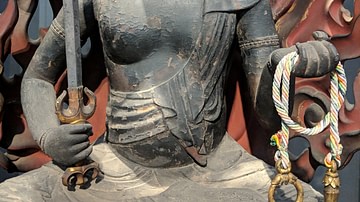
Fudo Myoo, King of Mystic Knowledge
Fudo Myoo, King of Mystic Knowledge, the Unbreakable, removes all spiritual fog on the way to salvation. He captures evil influences and sunders ignorance with his sword.
Japan, Fujiwara Period, end of the 12th century CE.
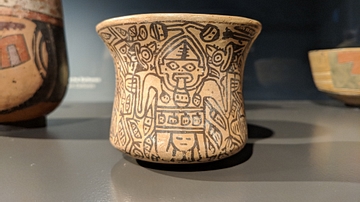
Image
Nazca Culture Vessel
Vessel from the Nazca Civilization. Peru, 2nd to 6th century CE. Fired clay.
Exhibited at Museum Rietberg, Zurich, Switzerland.
